Five years ago, choosing a hotel for a business trip could feel fairly predictable. Find something near the meeting, stay within the company rate, make sure the Wi-Fi works, and collect your loyalty points. Those basics still matter, but the business-travel environment surrounding them has changed considerably.
Hybrid work, higher hotel prices, tighter travel budgets, longer blended trips and new corporate sustainability goals are changing what both travelers and their employers look for. Recent research suggests that location remains king, but company policy, price, loyalty benefits, flexible amenities and the ability to combine work with personal time now influence the decision in important ways.
The result is not that business travelers have abandoned conventional business hotels. In fact, BCD Travel's 2025 survey of 1,035 business travelers found that midscale and upscale hotels remained the most common choices. What has changed is the calculation travelers make before they click "book."
Location Still Comes First
For all the changes in business travel, convenience has not gone out of style. BCD Travel's 2025 survey, covering travelers in North America, Europe and Asia Pacific, found that 77% considered location important when choosing accommodation. Employer policy came next at 56%, followed by cost at 53%.
That makes sense when you consider what a poorly located hotel can add to a trip. Staying far from a client, convention center or office can mean additional transportation, longer travel times and less flexibility during the working day. A slightly cheaper room is not necessarily much of a bargain if reaching it requires repeated taxi or rideshare trips.
The interesting part is what comes after location. Past experience with a property, hotel brand and participation in a loyalty program were also significant factors in BCD's research. Business travelers are therefore balancing practical concerns with familiarity and benefits rather than simply hunting for the lowest nightly rate.
Price pressure, however, is becoming harder to ignore. Deloitte's 2025 Corporate Travel Study found that 54% of travel managers ranked costs among the three biggest factors restricting business travel, up from 48% in 2024. Deloitte also noted that corporate hotel room rates rose in 2024 while airfares declined.
That has put hotels directly in the sights of corporate cost controls. Fifty percent of travel providers surveyed by Deloitte said travelers were being encouraged to select less expensive lodging, compared with 37% who reported encouragement to choose cheaper airfares. A familiar upscale property may still appeal to travelers, but today's cost pressures give them more reason to compare it with a less expensive option nearby.
The Room Has To Work
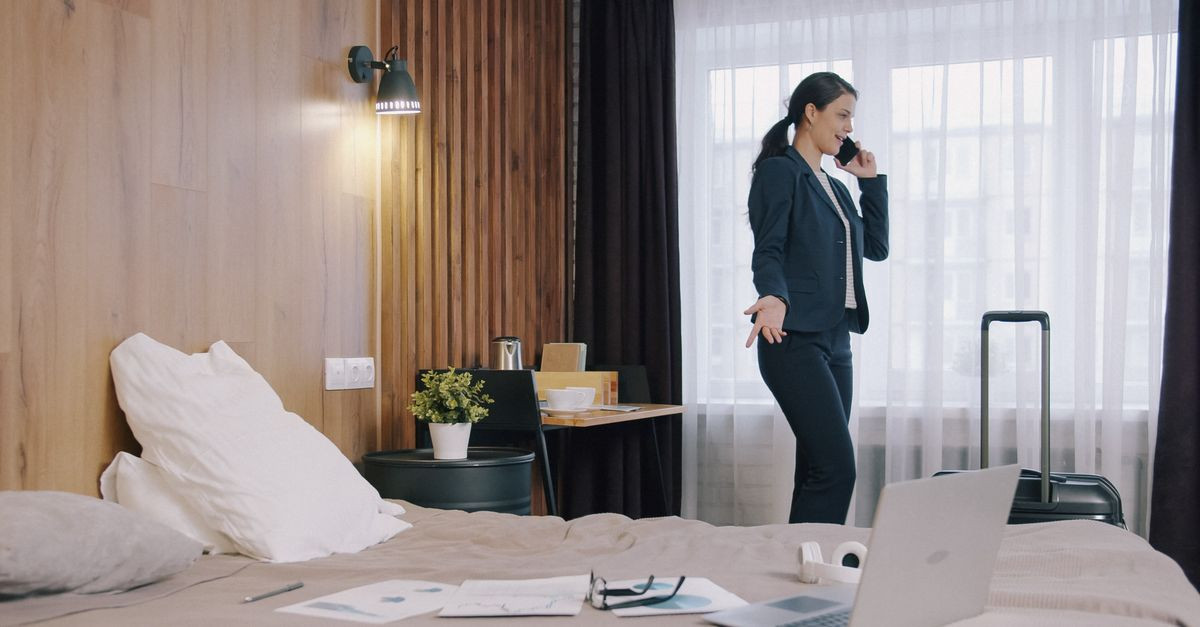
The hotel room itself is also being asked to do more. Business travelers may need somewhere to answer email before breakfast, join a video call between meetings or finish a presentation in the evening. Reliable connectivity and a room that supports both working and resting can therefore have practical value beyond comfort.
BCD's 2025 research found several recurring complaints among corporate travelers. Slow Wi-Fi, breakfast not being included, outdated rooms and uncomfortable beds were among the problems travelers reported during hotel stays. The same research found demand for amenities including on-site restaurants and bars, parking, fitness centers and flexible check-in and checkout.
Wellbeing features also matter to some travelers. BCD found travelers valued amenities such as gyms, pools, spas, healthy food choices and complimentary bottled water. That fits a business-travel environment in which a hotel is not necessarily just somewhere to sleep between a late arrival and an early meeting.
The comparison with earlier business-travel research is revealing. GBTA reported a decade ago that 61% of North American business travelers used free in-room Wi-Fi available to all guests, while another 16% received free access through direct booking, loyalty membership or special status. Even then, internet access was an important hotel consideration.
What has changed is the range of tasks that connectivity may support. Remote and hybrid working have made video meetings and cloud-based collaboration ordinary parts of professional life, while business trips increasingly include team gatherings and training as well as traditional sales calls. Deloitte found that training and development had become one of the fastest-growing drivers of corporate travel in 2025. One in five travel managers named it as their company's top driver of travel growth, while 49% of travelers had taken or expected to take a training trip.
Work Trips Are Getting Blended
Another major change is that the boundary between business and leisure travel has become less rigid. BCD's 2025 hotel survey found that six in 10 business travelers occasionally combine business trips with leisure. Four in 10 may bring a partner, family member or friend, although most said they did so rarely.
Deloitte found an even stronger indication of the trend in its 2024 corporate-travel research. Two-thirds of corporate travelers surveyed said they had extended a business trip for leisure during 2023. One in seven reported doing it three or more times.
That can change what makes a hotel attractive. A property chosen for a two-night business stay might also become the base for a weekend in the city. Location near the office still matters Monday morning, but access to restaurants, attractions or neighborhoods worth exploring can suddenly matter on Saturday.
Longer stays can alter the preferred accommodation itself. BCD found that travelers who sometimes use apartments considered them convenient for extended stays because they offered more space and the ability to prepare meals and do laundry. That gives serviced apartments and apartment-style accommodations an advantage for certain trips that a conventional hotel room may not match.
Hotel companies have noticed the overlap. Hilton's 2025 Trends Report found that 25% of global respondents planned to travel more for "bleisure," while the company pointed to apartment-style extended-stay accommodation as one response to travelers combining work and personal time. Hilton's findings came from global research involving 13,000 travelers across 13 countries.
This does not mean every business traveler now wants a kitchenette and a weekend sightseeing itinerary. It does mean the old distinction between the "business hotel" and the "leisure hotel" is less useful on some trips. A property that can handle both sides of the journey has a stronger case for the booking.
Loyalty Still Has Pull
If there is one decidedly traditional hotel habit that remains powerful, it is collecting points. BCD's 2025 survey found that 80% of business travelers belonged to a hotel loyalty program. In North America, membership reached an extraordinary 99% among respondents.
Many travelers are not loyal to just one program. Three-quarters of respondents belonged to multiple hotel loyalty schemes, while two-thirds often or always chose hotels affiliated with their programs. Importantly, 75% said their employers allowed them to keep points earned on business accommodation.
Those benefits can influence where travelers book as well as where they stay. Deloitte's 2024 study found that loyalty points were among the reasons corporate travelers booked directly with hotel and airline suppliers rather than through other channels. Easier management of itinerary changes was an even bigger attraction of booking direct.
Corporate booking channels are nevertheless becoming more important again. Deloitte found that 49% of frequent travelers surveyed in 2025 said they always used corporate channels, up from 43% in 2024. Among travelers who sometimes booked elsewhere, use of corporate channels for hotels rose from 26% to 44%.
BCD similarly found that more than three-quarters of travelers used their company's online booking tool to search for accommodation. That means the modern hotel decision may involve three overlapping interests: what the traveler wants, what the employer permits and what the booking platform actually displays.
That balance helps explain why loyalty has not disappeared even as corporate controls tighten. A hotel that satisfies company policy, sits near the meeting and belongs to a traveler's preferred loyalty program can check several boxes simultaneously. The familiar brand still matters, but it increasingly has to earn its place alongside price and policy.
Sustainability Is Entering The Search
Sustainability adds another factor that was far less visible in the hotel booking process five years ago. Deloitte found that 40% of travel buyers surveyed in 2025 said their booking tools flagged hotel sustainability certifications and ratings. That represents a practical shift because environmental information can now appear while an employee is actually comparing properties.
Companies are also putting more pressure on travel programs generally. Deloitte found that 48% of travel managers cited sustainability commitments among the top three factors restricting travel in 2025, up from 38% in 2024. Forty-five percent said their organizations' emissions targets required reducing travel by at least 20%.
Travelers themselves appear more cautious about making sustainability the deciding factor in a hotel choice. BCD found that only 16% considered environmental factors when booking accommodation, while half said they never or rarely considered sustainability. About one in five looked for features such as eco-certifications, reduced single-use plastics, lower emissions, water conservation or limited housekeeping.
That distinction is important. Sustainability is becoming more visible in corporate policy and booking technology, but the evidence does not support saying it has overtaken location, price or loyalty for travelers themselves. In BCD's survey, sustainability ranked at the bottom of the factors influencing hotel selection.
Taken together, these changes mean travelers and companies are weighing hotel choices in a different business-travel environment than they were five years ago. Travelers are still looking for convenience and comfort, but employers are watching hotel costs more carefully, booking platforms are influencing the available choices, blended trips are changing what travelers need from a property, and sustainability information is becoming easier to see.
The modern business traveler is not necessarily looking for a fancier hotel. In many cases, the better choice is simply the property that does more jobs at once. It needs to fit company policy, keep the commute manageable, support a working day, offer useful amenities and perhaps make an extra leisure night worthwhile. That is a much more complicated hotel search than simply finding a bed near tomorrow's meeting.