
For a few strange months in 2020, the future of business travel seemed almost embarrassingly obvious. Offices closed, conferences vanished, sales teams stopped boarding planes, and millions of employees discovered that meetings once considered important enough to justify an airport run could be handled from a laptop. Zoom reported that its platform had grown from about 10 million daily meeting participants in December 2019 to more than 300 million by April 2020. Suddenly, the idea of flying several hours simply to sit across a conference table from someone seemed like a relic from another era.
Companies had an equally compelling financial reason to rethink the habit. The Global Business Travel Association estimated that worldwide business travel spending dropped from roughly $1.4 trillion in 2019 to about $694 billion in 2020, a collapse of approximately 52 percent. Zoom, meanwhile, reported fiscal 2021 revenue of $2.65 billion, an extraordinary 326 percent increase from the previous fiscal year. The symbolism was difficult to miss: corporate travel was experiencing one of the worst shocks in its history just as videoconferencing was becoming a normal part of the working day.
It was tempting to assume that this was not merely a temporary disruption but a permanent technological replacement. If a salesperson could pitch a customer online, an executive could address a team from home, and colleagues on three continents could review the same spreadsheet without leaving their desks, why would corporations ever return to their old travel budgets? That prediction turned out to contain an important piece of truth, because many routine trips never regained their former importance. What it missed was that business travel performs several jobs at once, and not all of them translate equally well to a screen.
That distinction has become particularly clear in 2026. GBTA now forecasts that global business travel spending will reach a record $1.71 trillion this year, while workers will take approximately 1.84 billion business trips worldwide. Spending is expected to increase 7.2 percent from 2025, but trip volume is forecast to rise by only about 1.3 percent. Companies are therefore not simply recreating the pre-pandemic world; they are spending more while becoming increasingly selective about which journeys deserve to happen at all.

The Pandemic Really Did Break The Old Travel Model
The survival of corporate travel should not be mistaken for evidence that the great videoconferencing experiment failed. It worked extraordinarily well for a large category of interactions, and employers now have years of experience proving that colleagues do not need to occupy the same physical room every time they exchange information. Project updates, recurring departmental meetings, straightforward presentations, approval sessions, and many one-on-one conversations can happen online with relatively little friction. That discovery permanently raised the bar a business trip has to clear before a company agrees to pay for it.
Before 2020, the alternative to traveling was often treated as a compromise. A manager visiting another office might automatically book a flight because physical presence was simply considered part of doing business, even if the agenda consisted mostly of discussions that could have happened remotely. The pandemic forced organizations to operate without that default, and many found that work continued anyway. What began as an emergency response eventually became a large-scale demonstration that physical travel and productive work were not as tightly linked as corporations had previously assumed.
The effects are still visible in current travel policy. Deloitte's 2025 Corporate Travel Study found that although most surveyed travel managers expected budgets to increase, companies were also confronting growing pressure from costs, sustainability considerations, and changing employee expectations. The largest organizations showed particular caution, with one in five companies spending more than $7.5 million annually on travel expecting their budgets to decline in 2025. Business travel recovered, but the old assumption that growth automatically meant sending more people on more trips did not.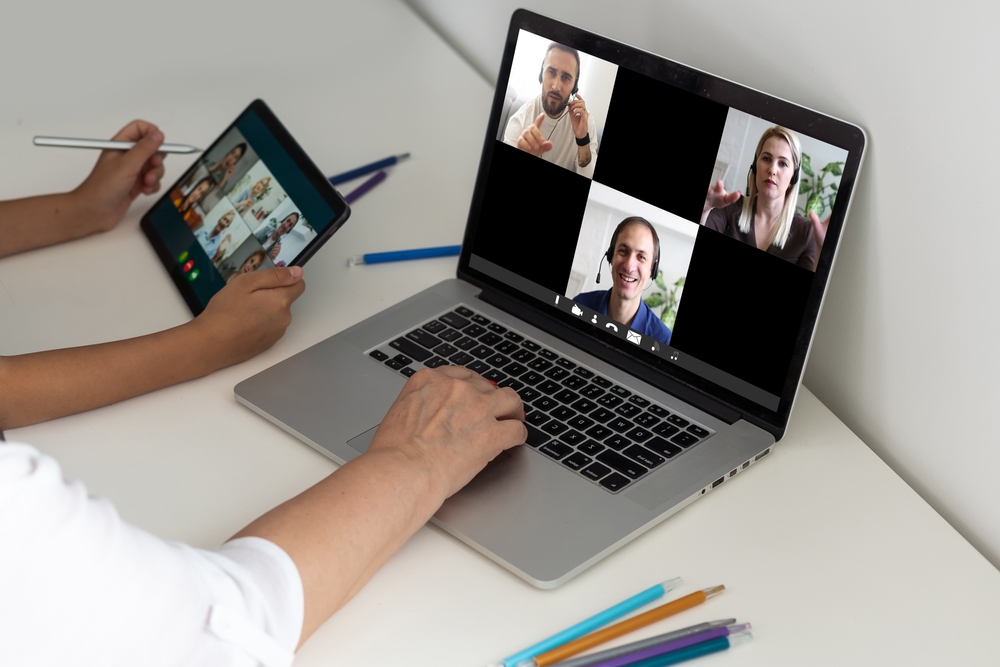 Andrew Angelov, Shutterstock
The financial picture makes that shift even clearer. GBTA estimated that global business travel spending reached $1.47 trillion in 2024, nominally above the pre-pandemic record, but it cautioned that inflation-adjusted spending remained below 2019 levels. That meant companies were once again spending enormous amounts of money without necessarily buying the same volume of travel they once did. Higher airfare, accommodation, food, and transportation costs can push the dollar total upward even while organizations remain disciplined about trip frequency.
This is the first major reason Zoom did not kill business travel. Videoconferencing did not have to eliminate every flight in order to transform the industry, because replacing millions of lower-value meetings was already a profound change. Corporate travelers are operating in a world where the virtual meeting is no longer an inferior backup plan but a legitimate competitor to getting on an airplane. The trips that remain increasingly need a reason beyond the fact that someone has always traveled for that meeting.
Zoom Won The Routine Meeting, Not The Whole Relationship
A video call is remarkably efficient at moving information. Employees can present financial results, review a contract, demonstrate a product, discuss timelines, and make decisions with people scattered across multiple countries without anyone losing a day to airports and ground transportation. For businesses managing hundreds or thousands of meetings every week, those savings can be substantial even when they are difficult to quantify precisely. The fact that companies continue buying videoconferencing tools while also increasing travel spending shows that the two forms of communication now coexist rather than simply replacing one another.
The limitations appear when the purpose of a meeting shifts from transmitting information to creating something new. Research published in Nature in 2022 compared pairs collaborating through videoconferencing with pairs working face to face, using laboratory experiments as well as a field study involving employees in five countries. The researchers found that virtual pairs generated fewer creative ideas, although they found no evidence that videoconferencing made people worse at choosing which idea to pursue. The implication was not that virtual meetings are inherently inferior, but that different forms of collaboration can favor different kinds of work.
The researchers also explored why that gap might exist. Participants on video tended to focus more narrowly on their screens, while people sharing a physical space looked around their broader environment more frequently, a difference associated with creative idea generation in the experiments. Other measures, including trust, did not reveal a simple across-the-board advantage for face-to-face collaboration. That nuance matters for businesses deciding how to structure work because it suggests that the correct question is not whether online meetings are good or bad, but whether they suit the specific task being performed.

That task-specific logic has become embedded in how many organizations approach travel. A weekly project update involving people who already know one another may offer little additional value when conducted in person, especially if half the participants must fly to attend it. A strategy workshop, complicated negotiation, new-client meeting, or collaborative design session can present a different calculation because conversation is only part of what participants are trying to accomplish. Companies can therefore cut routine travel aggressively while continuing to spend heavily on occasions where they believe physical interaction changes the quality of the outcome.
Relationships complicate the equation further. Video can keep an existing professional relationship functioning efficiently, particularly when both sides already understand one another's personalities, priorities, and expectations. Building that familiarity from scratch can be different, especially when a deal requires trust across organizations, cultures, or time zones. Business travelers are increasingly being sent not because companies lack a digital alternative, but because decision-makers believe the relationship is important enough to justify something more than the digital alternative.
The result is a corporate communications system that would have looked unusual before 2020. Teams can spend weeks preparing for an important customer meeting through video, fly a smaller group to meet the customer in person, and then conduct months of follow-up online. One physical trip can sit inside a much longer sequence of digital interactions rather than replacing them. In that model, Zoom does not compete with travel so much as reduce the number of journeys required to sustain the same relationship.
The Trips Closest To Revenue Still Get On The Plane
When corporate budgets tighten, travel connected to customers has a built-in advantage. Deloitte's 2025 study found that connecting with external stakeholders remained the most common purpose for business travel among the organizations surveyed. New business development, face-to-face engagement with clients and partners, and conferences were all among the major reasons companies expected their travel needs to grow. These are exactly the kinds of activities in which the cost of not showing up can seem more consequential than the price of a ticket.
That does not mean every customer wants a parade of executives arriving at the office. Buyers have spent the same years getting comfortable with video calls, and many sales processes now move through digital stages that would once have generated multiple visits. Initial conversations, demonstrations, technical questions, contract discussions, and follow-up meetings can all be conducted remotely when both sides find that convenient. What survives is often the moment in the relationship when physical presence appears most likely to affect the result.
Consider a business competing for a major account. Several vendors may be capable of delivering polished presentations over video, but one may decide that the final pitch is important enough to put its senior team in the same room as the prospective customer. Whether that produces a measurable advantage will depend on the situation, and businesses are increasingly being asked to demonstrate that connection rather than merely assume it. The decision to travel becomes an investment argument centered on the value of the opportunity.
 pain au chocolat, Shutterstock
Existing customers also generate trips that are difficult to reduce to a conventional sales call. Large implementations can involve equipment, facilities, training, technical troubleshooting, or complicated coordination among teams that work for different organizations. A few concentrated days together may sometimes resolve issues faster than a long series of scheduled virtual meetings, particularly when problems are interconnected. Companies can still handle most routine communication online while reserving travel for the points at which a project needs intensive attention.
International travel demonstrates the same pattern on a larger geographic scale. Deloitte reported in its 2025 study that international trips represented roughly half of travel spending among respondents, broadly similar to the previous year. Global commerce continues to involve customers, suppliers, factories, professional services firms, technology installations, investment projects, and partnerships spread across national borders. Digital communication makes those networks easier to operate, but it does not make their physical components disappear.
GBTA's 2026 forecast offers another clue about where travel demand is coming from. The organization identified artificial intelligence and technology investment as emerging drivers of business travel, particularly in North America and Asia Pacific, linking investment in digital infrastructure, data centers, and enterprise technology to project work and customer engagement. There is a certain irony in advanced technology helping generate new reasons for humans to travel. Building a more digital economy can require engineers, salespeople, technicians, executives, and project teams to visit the physical infrastructure that supports it.
Conferences Turned Out To Be Harder To Replace Than Expected
If any major category of business travel seemed destined for virtual replacement in 2020, conferences were an obvious candidate. Keynote speeches could be streamed, panel discussions could become webinars, product demonstrations could move online, and thousands of attendees could avoid flights and hotel bills. Virtual events briefly seemed capable of reproducing the central function of a conference at a fraction of the logistical cost. Once physical gatherings returned, however, it became clear that presentations had never been the only product conferences were selling.
Deloitte's 2025 research found that nearly two-thirds of business travelers expected to attend a conference during the year, making live events a major driver of travel. Conferences were also among the leading factors travel managers cited when explaining increases in business travel. That resilience makes more sense when an event is viewed as a concentrated marketplace of people rather than merely a sequence of speakers on a stage. An attendee can potentially meet clients, suppliers, prospective customers, colleagues, and competitors within the same few days.
That concentration can make an event more efficient than a series of separate trips. A salesperson who would otherwise have to arrange individual visits to several customers may encounter many of them at a single industry gathering. Executives can schedule formal meetings while also benefiting from introductions and informal conversations that were not on the calendar when the trip began. Deloitte noted that smaller companies in particular appeared to use conferences as opportunities to engage multiple external stakeholders over a short period.
The informal element is particularly difficult to reproduce online because virtual meetings are usually organized around a defined beginning, agenda, and ending. Physical events create time between scheduled activities, including receptions, meals, hallways, exhibition floors, and conversations that happen because two people unexpectedly encounter one another. Companies cannot guarantee that those moments will produce a contract or useful idea, which is one reason measuring event ROI remains complicated. They can still decide that the density of potential interactions makes attendance strategically worthwhile. Matej Kastelic, Shutterstock
The meetings industry itself is increasingly emphasizing that distinction. American Express Global Business Travel's 2026 Meetings and Events Forecast describes human connection and deeper engagement as central priorities even as technology and artificial intelligence take larger roles in planning events. The forecast also points to rising budgets and greater interest in data-driven approaches, productivity, sustainability, and attendee experience. The modern corporate event is therefore becoming more technological at the same time that organizers are trying to make the in-person component more valuable.
Training is contributing to the comeback as well. Deloitte found that increased demand for learning and development was among the fastest-growing reasons for corporate travel in its 2025 study, with two-thirds of surveyed travel managers reporting increased spending in the category. Nearly half of surveyed business travelers either had traveled or expected to travel for training during the year. Companies that are adopting new technologies may rely heavily on online instruction while still bringing some employees together for intensive sessions that benefit from hands-on work, discussion, or collaboration.
Hybrid Work Created New Reasons To Meet In Person
Remote and hybrid work initially appeared likely to weaken business travel even further. If an employee no longer needed to be in a company office five days a week, it seemed logical that there would also be fewer reasons to visit other offices. That prediction was partly correct because distributed organizations became more comfortable conducting internal business virtually. Yet the disappearance of everyday office contact also changed the meaning of the occasions when teams actually do gather.
A conventional office generates countless small interactions without requiring anyone to organize them. Coworkers ask quick questions, eat together, overhear discussions, introduce people from different departments, and solve minor problems simply because they happen to be nearby. A distributed workforce can recreate many functional aspects of that environment through messaging and video tools, but encounters must generally become more intentional. When a company finally brings a remote team together, the gathering can carry more weight because employees no longer receive that face-to-face contact automatically.
That helps explain why some internal travel has evolved rather than disappeared. Instead of routinely flying employees to headquarters for standard departmental meetings, organizations can organize less frequent planning sessions, leadership meetings, training programs, team events, or project launches. The number of journeys may be lower, but the schedule can be denser and the objectives more ambitious. A two-day gathering might combine strategic planning, training, workshops, social interaction, and meetings that would once have been spread across several separate trips. gorgev, Shutterstock
This model also changes the expectations placed on organizers. If employees are being asked to leave home, navigate airports, and give up several days of their normal routines, a gathering consisting mostly of PowerPoint presentations can feel difficult to justify. Meeting planners increasingly have to consider what participants can accomplish together that they could not accomplish as effectively from their desks. Amex GBT's 2026 forecast emphasizes engagement, productivity, and lasting impact, reflecting an industry in which the value of the physical gathering itself is under closer examination.
Hybrid work therefore produces what initially looks like a contradiction. An organization can rely more heavily on remote communication and simultaneously place greater importance on selected in-person gatherings. The same technology that eliminates dozens of ordinary meetings can make the remaining physical meeting feel more consequential. Instead of traveling because being in the office is normal, employees travel because an organization has identified a particular moment when gathering people together is supposed to accomplish something distinct.
For travelers, this can mean a smaller number of more intensive trips. The employee who once traveled monthly for routine meetings might now make only several journeys each year, but those journeys could involve longer agendas, multiple objectives, or larger groups of colleagues. That pattern fits the broader industry data showing travel spending growing considerably faster than the number of actual trips. Business travel is not simply returning; it is becoming more concentrated.
CFOs Are Spending More, But They Want Receipts
Perhaps the strongest evidence that corporate travel still matters comes from the people responsible for watching the money. SAP Concur's 2026 Global Business Travel Survey found that 97 percent of the CFOs it surveyed considered business travel important to their organization's overall growth strategy. Eighty-two percent expected their company's travel budget to increase during the year. Those are striking numbers for an expense category that was widely expected to be permanently diminished by videoconferencing.
The same survey also revealed the pressure sitting behind those budgets. Eighty-nine percent of CFOs agreed that travel managers needed to do a better job demonstrating how business travel helps their companies meet business goals. Travel managers, for their part, reported difficulty proving return on investment without stronger support from finance leadership. The corporate conversation has therefore moved beyond the simple question of whether employees should travel and toward the more demanding question of what the organization receives in exchange for each journey.
That distinction is transforming how travel programs are managed. A sales trip can potentially be connected to a customer opportunity, while a conference can be evaluated using meetings booked, leads generated, partnerships developed, or other business outcomes. Internal gatherings are harder to measure because improvements in collaboration or employee relationships do not always produce an immediate line on a financial statement. The inability to assign every trip a precise dollar return does not eliminate its value, but it does make companies less willing to accept vague explanations for why travel is necessary.
Cost pressure is reinforcing that discipline. Deloitte reported that 54 percent of travel managers surveyed in 2025 placed costs among the top factors restricting corporate travel, while the percentage expecting budget cuts had increased from the previous year. Companies are confronting airfare, hotel rates, ground transportation, employee time, and administrative expenses at once. A meeting that seemed worth a $500 trip can look very different when the complete cost of sending someone rises substantially.
Sustainability adds another layer. Deloitte found that environmental commitments were also becoming a more important constraint on travel, creating pressure for companies to consider whether journeys support organizational goals strongly enough to justify their impact. The practical responses can include reducing unnecessary flights, encouraging rail on appropriate routes, consolidating meetings, or sending fewer employees to the same event. These approaches do not require corporations to abandon business travel; they require them to become more selective about its use.
Employees themselves are also part of the calculation. SAP Concur's 2026 survey found that business travelers continued to see value in work trips while expressing concerns about disruption, safety, unpredictability, and how companies monitor them during travel. A successful corporate travel program consequently has to satisfy several constituencies at once: finance leaders want measurable value, travelers want reasonable support and flexibility, and companies want business outcomes. Simply ordering people onto airplanes because that was standard practice before 2020 is no longer enough.
Record Spending Does Not Mean A Return To The Old Days
At first glance, the headline number from 2026 looks like a complete victory for the old-fashioned business trip. GBTA expects global corporate travel spending to reach $1.71 trillion, higher in nominal dollars than anything recorded before the pandemic. The organization says spending grew 8.4 percent in 2025 and forecasts another 7.2 percent increase in 2026. If money were the only measure, it would be easy to conclude that the corporate world had simply returned to its previous habits.

Trip volume tells a more complicated story. GBTA estimates that workers took about 1.82 billion business trips worldwide in 2025 and expects approximately 1.84 billion in 2026, an increase of only 1.3 percent. That is roughly 25 million additional trips, a substantial number in isolation but modest compared with the projected growth in total spending. GBTA specifically points to elevated transportation and travel costs as one of the reasons the financial total is rising much more quickly than actual travel activity.
The composition of that travel also varies enormously by region and industry. GBTA's 2026 forecast identifies the United States and China as the two largest business travel markets by spending, while Asia and Europe account for particularly large numbers of trips. It also notes that rail plays a significant role for business travelers in Europe and Asia Pacific, reminding companies that corporate mobility involves much more than long-haul aviation. The global business traveler of 2026 may be flying across an ocean, riding a train between nearby cities, or combining several modes into one tightly planned journey.
Travel frequency is also far from uniform. In GBTA's 2026 survey, 41 percent of respondents reported taking one or two business trips during 2025, 44 percent took between three and ten, and 15 percent took more than ten. Nearly three-quarters said they were traveling as much as or more than in previous years, although patterns differed across regions. Those figures describe a world in which business travel remains common without suggesting that every employee has returned to an airport-heavy pre-pandemic routine.
What has returned most decisively is the willingness to travel when businesses believe the objective warrants it. A client opportunity, project deployment, international partnership, conference, training session, or strategically designed team gathering can still clear that threshold. A routine status update often will not. Video technology did not erase distance, but it gave employers a cheap and familiar way to avoid paying to overcome that distance every single time people need to talk.
That is why asking whether Zoom killed business travel frames the question incorrectly. Zoom and similar platforms succeeded precisely because companies kept using them after employees returned to airports, hotels, offices, and convention centers. The technology absorbed enormous amounts of communication that once might have generated travel while allowing companies to preserve face-to-face interaction for selected purposes. The two systems are now complementary parts of the same corporate operating model.
The business trip that survived this transition is consequently under more pressure to earn its place on the calendar. Before the pandemic, the fact that an important meeting was happening could sometimes be sufficient justification for attending it physically. Today, managers can reasonably ask why a video call is not enough, whether several objectives can be combined into the same journey, who actually needs to attend, and what outcome the organization hopes to achieve. Those questions can reduce travel without eliminating it.
In that sense, the lasting revolution was not the death of corporate travel but the end of unquestioned corporate travel. Companies now have proof that vast amounts of work can happen across continents without anyone leaving home, and they use that capability every day. Yet they also have evidence from their own operations, customers, events, and projects that some moments still justify putting people in the same physical place. The existence of one option has made businesses more demanding about the other.
So Zoom did not kill the business trip. It killed the simpler assumption that conducting business and traveling for business were naturally inseparable. In 2026, companies can operate globally through screens for most of the working week and still spend record amounts when they believe a customer, project, conference, training program, or relationship deserves physical presence. The business trip survived, but now it has to make a much stronger case for itself before anyone heads to the airport.
You May Also Like:
AI Is Completely Changing How We Book Business Trips In 2026
Remote Workers Are Creating A Strange New Kind Of Business Travel
Gen Z Is Changing Business Travel. Here’s What Younger Workers Want From A Work Trip