
The return of business travel has created an awkward question for companies that spent the past several years making ambitious climate promises. Meeting customers, visiting factories, attending conferences, and bringing distributed teams together can still produce real business value. Flying employees around the world, however, also produces emissions that increasingly show up in corporate climate accounting.
That does not mean companies are about to ground their employees. Instead, a more complicated model is emerging in which organizations measure the emissions associated with travel, scrutinize which trips deserve to happen, and give workers more ways to choose lower-carbon options. The goal is becoming less about eliminating business travel and more about making every trip easier to justify.
Business Travel Is Now Part Of The Climate Math
For companies tracking their greenhouse gas footprint, business travel is generally classified as a Scope 3 emission. The Greenhouse Gas Protocol places emissions from employee transportation for business purposes, including aircraft, trains, buses, and cars operated by outside companies, in Scope 3 Category 6. Hotel stays can also be included in a company's calculations.

That accounting distinction matters because Scope 3 emissions are generated outside a company's own facilities, but they can still represent an important part of its climate impact. Once a company has promised to reduce its wider value-chain emissions, travel managers can find themselves working toward the same environmental targets as sustainability and procurement departments. Business trips that were once viewed almost entirely through the lenses of price, convenience, and employee productivity can suddenly carry another measurable cost.
Corporate travel programs are responding. In the GBTA Foundation's 2024 sustainability benchmark, 62% of participating companies said they were tracking business-travel emissions, while another 14% planned to begin doing so within a year. Nearly half were already publicly disclosing Scope 3 emissions, with another 14% planning to start.
Salesforce offers a useful example of how travel can fit into a larger emissions strategy. The company said in its FY25 Stakeholder Impact Report that business travel represented about 7% of its annual market-based emissions on average, with air travel responsible for most of that share. Salesforce said it uses internal air-travel reduction targets, digital collaboration tools, and leadership campaigns to influence behavior, and reported that the number of employee flights fell 8% from the previous fiscal year.
Fewer Trips Can Mean More Valuable Trips
One of the simplest ways to reduce travel emissions is also the most obvious: take fewer trips. That does not necessarily require companies to stop meeting customers or bringing teams together. It can mean asking whether a trip is important enough to warrant the money, employee time, and emissions it creates.
The idea was already appearing in corporate travel programs before the latest wave of climate commitments. A 2023 GBTA Foundation survey found that 74% of travel managers either encouraged or required employees to combine multiple business trips into a single journey. Thirty-eight percent said they requested justification for same-day trips based on return on investment and whether alternatives were available.

That logic fits neatly with the way companies have become more selective about travel since the pandemic. Rather than restoring every pre-2020 trip, employers can prioritize travel that is difficult to reproduce through a video call. Major sales meetings, site visits, relationship-building events, negotiations, training sessions, and team gatherings may make the cut, while a routine internal meeting becomes harder to justify.
Deloitte's 2024 corporate travel study found that many travel managers believed their organizations would need to reduce travel in order to hit sustainability targets. More than half said trip volumes would need to fall by between 10% and 20%. At the same time, 46% said their companies had a strategy for assigning travel emissions budgets to teams or individuals, up from 30% in Deloitte's 2023 survey.
That is an important change in thinking. A department with both a financial travel budget and an emissions budget has an incentive to ask not only whether it can afford a trip, but whether that journey is the best use of its limited carbon allowance. In practice, that could make a strategically important international trip easier to defend while putting more scrutiny on a series of low-value flights.
Booking Tools Are Becoming Climate Tools
Companies can also reduce emissions without canceling a trip at all. Travel policies increasingly try to steer employees toward lower-emission flights, rail journeys, electric vehicles, and other alternatives during the booking process.
The GBTA Foundation's 2024 benchmark found that 68% of participating companies had sustainability features in their corporate travel booking platforms. Another 22% were considering upgrading or moving to a platform with stronger sustainability capabilities. The same research found widespread use of policies encouraging or mandating economy class for domestic travel.
This is where technology can make a climate target feel less abstract to an employee trying to get from one meeting to another. Rather than sending travelers a sustainability report and expecting them to translate it into booking decisions, companies can place emissions information alongside the familiar variables of schedule and price.
Those choices can be surprisingly detailed. Google Flights, for example, provides estimated emissions for individual flights and allows travelers to sort or filter results according to emissions. Its calculations account for factors including aircraft type, passenger load, cargo, distance, and seating class. Google notes that premium economy, business, and first-class seats are assigned higher emissions because they occupy more aircraft space.
Travelers appear open to receiving that kind of help. SAP Concur's 2024 global business travel survey found that 27% of respondents would consider declining a business trip because of its environmental impact or an inability to choose sustainable options. Thirty-seven percent said they would use AI-powered automation to find more sustainable choices when booking business travel.
The obstacle is that greener choices do not always align neatly with financial ones. In that same survey, 37% of travel managers said they struggled with demands to provide more sustainable travel options without enough budget, while 27% of travelers said their employers had reduced their willingness to pay extra for more sustainable alternatives.
Carbon Fees And SAF Add Another Layer
Some companies are putting an internal price on emissions rather than relying entirely on voluntary employee choices. Microsoft has used an internal carbon fee since 2012, initially covering Scope 1, Scope 2, and business air travel. The company later expanded the system to cover its wider Scope 3 footprint and charges business groups based on the emissions associated with their activities.
The principle is fairly straightforward. When carbon becomes an internal expense, emissions begin to influence budgets just as airfare and hotel rates do. A team that travels extensively therefore sees a financial consequence attached to that behavior, creating another incentive to consolidate trips or consider alternatives.
Still, carbon pricing remains far from universal. GBTA's 2023 climate-action survey found that only 10% of travel managers had established carbon budgets or fees, although another 23% were considering them. Eighteen percent of travel buyers were purchasing sustainable aviation fuel certificates, with another 16% planning to do so.
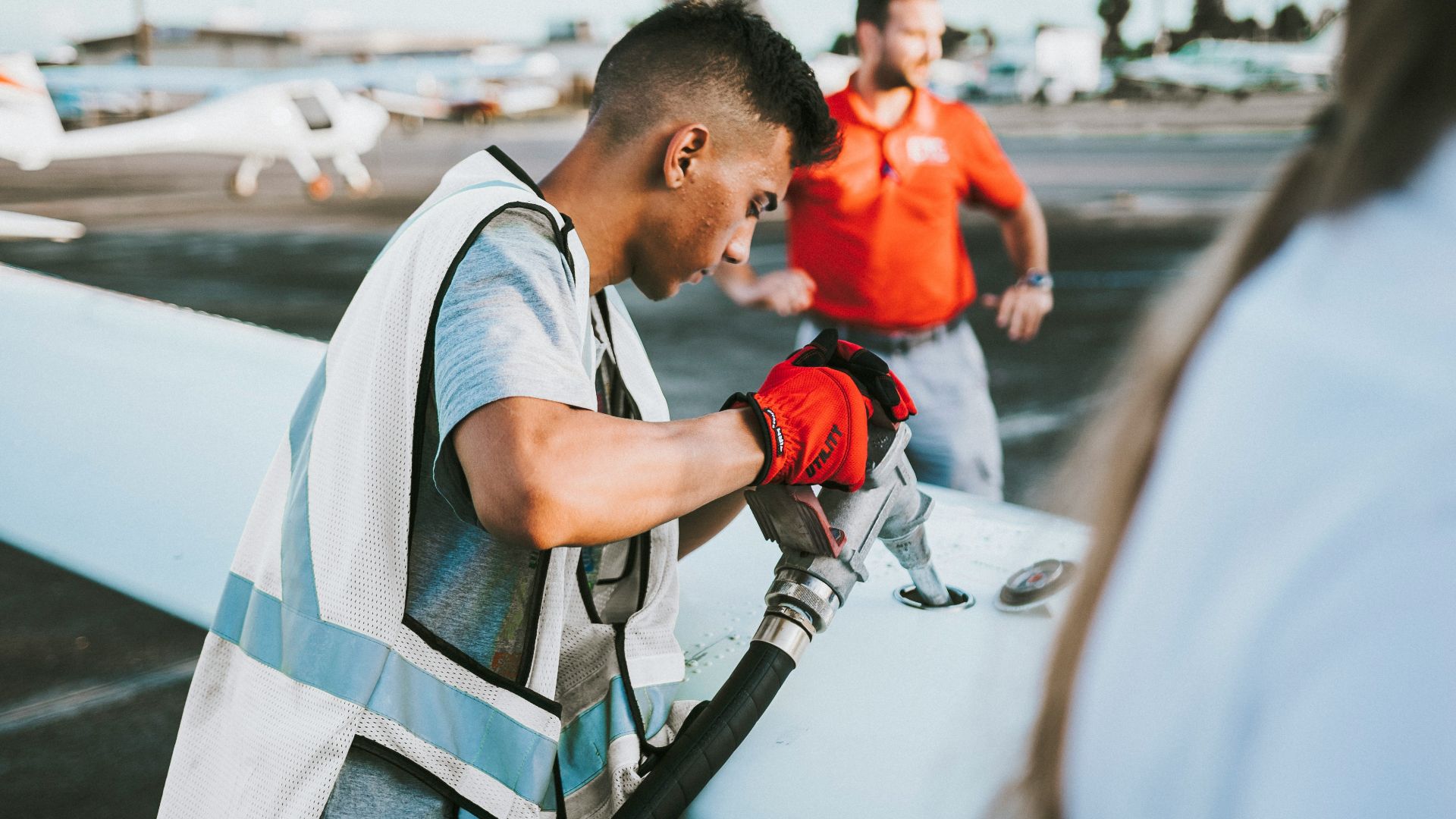
Sustainable aviation fuel, commonly called SAF, is attractive to companies because long-haul aviation has few immediate substitutes when employees genuinely need to travel. Yet supply remains a major constraint. The International Air Transport Association expected SAF production to reach about 2 million tonnes in 2025, equivalent to just 0.7% of total airline fuel consumption, even after doubling from the previous year.
Cost is another barrier. IATA estimated the average global price of SAF in 2025 at roughly 4.2 times the price of conventional jet fuel. That helps explain why companies can use SAF as part of a travel decarbonization strategy, but cannot realistically treat it as a complete solution to the emissions created by flying.
The Goal Is Smarter Travel, Not No Travel
The emerging corporate approach is therefore less dramatic than either side of the travel debate might suggest. Companies are not universally abandoning climate commitments because employees are flying again, nor are most attempting to eliminate travel entirely. They are trying to make travel more deliberate.
There is plenty of room for improvement. The GBTA Foundation's first global Sustainability Acceleration Benchmark gave corporate travel programs an overall maturity score of just 1.3 out of 5 in 2024. The result suggested that emissions measurement and sustainable booking features were spreading faster than the more difficult structural changes needed to substantially decarbonize travel.
Travelers may increasingly notice those changes themselves. A flight could require stronger justification. A train may appear ahead of an airplane in the booking system. Employees might see carbon information beside the ticket price, while managers could be asked to work within both dollar and emissions budgets.
None of those measures eliminates the basic tension. Face-to-face contact can matter enormously in business, and aviation remains difficult to decarbonize quickly. The companies making the most progress are increasingly treating those realities as reasons to make travel more selective, rather than reasons to ignore either the business value of a trip or its environmental cost.
For business travelers, that may be the most important change of all. The question is gradually shifting from whether companies should still allow people to travel to whether each particular trip earns its place in a climate-conscious travel program.
You May Also Like:
How AI Is Quietly Changing Corporate Travel Policies
Why Younger Workers May Be Less Willing To Sacrifice Their Personal Lives For Business Travel
Your Company’s AI May Soon Decide Whether Your Business Trip Is Worth Taking