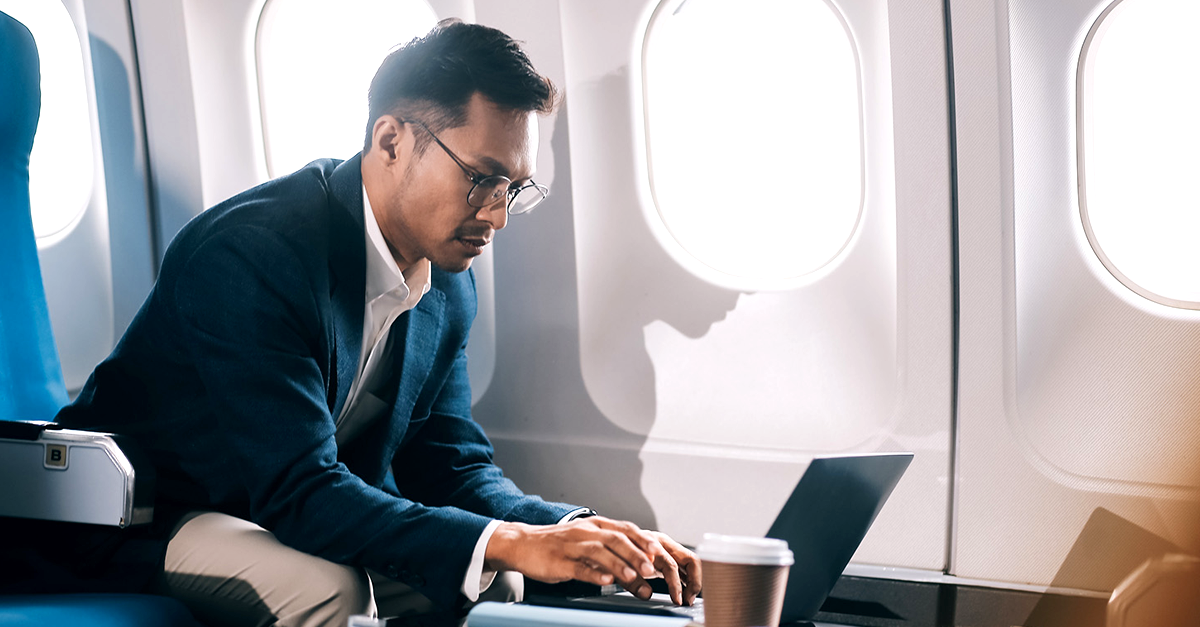
For decades, corporate travel policies incorporated business class seats as an assumed benefit. In 2026, that logic is being replaced by a more demanding question: What exactly is the company buying with the upgrade?
The answer now has to account for price, productivity, schedule, traveler well-being, flexibility, and carbon reporting. But that definitely doesn't mean corporate travelers are now being pushed to the back of the plane.
Morgan Stanley’s late-2025 survey of 160 corporate travel managers overseeing about $5 billion in global hotel and air spending found that premium-class policies were largely unchanged for 2026, while 8% said their rules actually were becoming more liberal.
Yet 37% of respondents were also looking for alternatives to reduce increasing travel expenses, up from 33%. The result is a market where companies can spend more on travel while still asking harder questions about each premium ticket.
Premium Travel Is Growing Even As Finance Teams Push Back
The airline data makes one thing clear: premium demand has not disappeared. Delta said premium corporate sales increased by more than 25% in the second quarter of 2026, while overall corporate sales grew by double digits across all sectors. American Airlines separately reported that its premium corporate travel bookings rose nearly 15% year over year during the 12 months ending in May 2026. Those are company-reported figures from two carriers, not a complete measure of the global market, but they show that businesses are still buying premium seats in meaningful numbers.
At the same time, employees are feeling the squeeze inside individual travel policies. In SAP Concur’s 2025 survey of 3,750 business travelers across 24 markets, 30% said their company had cut back on business or premium-class travel during the previous 12 months. The survey also found that travel-budget reductions often appear as small changes across many trips, such as requiring lower fares or cutting flight and hotel upgrades, rather than as one sweeping policy change. That helps explain why premium demand can remain strong even while individual travelers encounter more restrictions.
This is the central change in corporate premium travel. Business class is moving away from being an automatic status perk and toward being a trip-specific expense that needs a business case. A company can simultaneously approve a lie-flat seat for an overnight transatlantic sales trip and reject it for a daytime flight of similar length if the traveler has time to recover after arrival. The cabin has not lost its value, but the circumstances under which a company is willing to pay for it are becoming more important.
The change also reflects a broader shift in how companies think about business travel itself. Morgan Stanley’s survey projected corporate travel budgets to rise about 5% globally in 2026, yet travel-budget revisions and cost savings remained the leading concern that respondents said could negatively affect travel. In other words, a growing travel budget is not the same thing as a blank check. More money can simply mean more trips, higher market prices, or greater investment in the journeys that matter most.
The Fare Gap Has Become The Real Approval Test
The size of the fare difference is difficult for any finance team to ignore. A July 2026 forecast from the Global Business Travel Association and ALTOUR projected the average global economy fare at $536 for 2026, up 8.7% from 2025. Its broader premium category, which combines premium economy, business class, and first class, was projected at $4,488, up 9.5%.
That is why a useful corporate policy in 2026 can't rely on flight duration alone. A seven-hour flight with a modest upgrade difference is a different purchasing decision from a seven-hour flight where the premium fare costs several times more. Departure time matters too, because an overnight flight creates a different need than a daytime flight. So do connections, arrival time, the importance of the first meeting, and whether the traveler can reasonably arrive earlier.
There is also a distinction between buying a better seat and buying a more flexible ticket. Airlines increasingly separate those two ideas. Delta’s current fare structure includes a Basic Business option that still provides its lie-flat business-class onboard product, but the ticket comes with restrictions such as seat assignment after check-in, no refund after the risk-free cancellation period, and no same-day confirmed or standby changes. For travel from January 19, 2027, complimentary lounge access will also not be included with that fare.
That kind of unbundling makes corporate comparisons more complicated, but it can also make them smarter. A traveler heading to a fixed conference may care more about sleeping on the aircraft than about changing to an earlier flight at the last minute. A sales executive with an unpredictable itinerary may place a higher value on flexibility. The old question, “Is business class allowed?”, is increasingly too crude to capture what the company is actually purchasing.
Sleep Is The Strongest Case For Paying Up
If business class has a defensible core use case, it's the overnight long-haul trip where the traveler is expected to perform soon after landing. The US Centers for Disease Control and Prevention says jet lag can cause sleep disturbance, daytime sleepiness, cognitive impairment, general malaise, and gastrointestinal symptoms. Its Yellow Book also cites a survey in which 68% of international business travelers reported experiencing negative jet-lag symptoms regularly. That makes sleep and recovery a legitimate operational issue, not simply a question of comfort.
A small 2025 study published in the journal Sleep offers a useful look at what even business-class travelers actually experience. Researchers followed 53 passengers flying westward across six to eight time zones from Singapore to Europe. Passengers on night flights averaged about 6.1 hours of in-flight sleep, while those on day flights averaged about two hours. Even with business-class seating, however, post-flight sleep timing remained misaligned with local time and gradually realigned over four days.
But a lie-flat seat should not be confused with a cure for jet lag. The CDC recommends considering arrival at least two days before an important event so the body has time to adjust to the destination time zone. In some situations, an earlier arrival, additional hotel nights, and a lighter first day may be a better recovery strategy than relying on the cabin alone. In others, the schedule simply does not permit that buffer, which strengthens the case for paying for the best sleep opportunity available in transit.
For a company, the most sensible question is therefore not whether business class feels better. When the product includes substantially more space and a lie-flat bed, the more useful question is whether that additional rest protects working time that the itinerary cannot otherwise preserve. An overnight flight followed by a major client presentation creates a different return-on-spend calculation from a flight followed by a free afternoon and a full night at the hotel. Flight timing itself can meaningfully affect sleep before, during, and after long-haul travel.
Premium Economy Is Becoming The Corporate Middle Lane
The biggest threat to automatic business-class approval may not be economy. It is the growing usefulness of a middle option. Premium economy can give companies another way to improve the travel experience without automatically purchasing the highest available cabin, particularly on daytime long-haul journeys where in-flight sleep is less central to the itinerary. The right choice still has to be made route by route because fare structures and available cabins differ.
Corporate booking systems already show how that middle ground can be written into policy. American Express Global Business Travel’s GBT One platform, for example, lists a standard general policy in which business class is allowed on flights over six hours, while premium economy is allowed but economy is displayed first. The platform also allows administrators to restrict cabins, set price thresholds, and route out-of-policy selections to supervisors for approval. That is one platform’s default configuration, not a universal corporate standard, but it illustrates how easily companies can create multiple levels of acceptable travel.
Travelers themselves appear willing to pay for comfort when policy does not. SAP Concur’s 2025 survey found that 85% of business travelers would spend some of their own money on perks not covered by company policy, and 30% said they would pay personally for premium seating. That is useful evidence of perceived value, but it also exposes a potential policy problem. If employees routinely feel they need to self-fund a better seat to make a company trip manageable, the official travel standard may not be capturing the real demands of the journey.
Premium economy therefore works best as a deliberate option, not a universal compromise. On some overnight routes, an upright premium seat may not provide the same sleep opportunity as a lie-flat product. On some daytime flights, the intermediate cabin may meet the traveler’s practical needs without paying for the full business-class experience. The important change is that companies now have more ways to structure cabin and fare policies than a simple economy-or-business rule.
Sustainability Changes The Mathematics
Premium travel also carries a carbon-accounting consequence because a larger seat occupies more aircraft space. The UK government’s 2026 greenhouse-gas conversion methodology assigns long-haul economy travel an average factor of 63.7 grams of carbon-dioxide-equivalent per passenger-kilometer and long-haul business class 184.9 grams, excluding distance and radiative-forcing uplifts. Premium economy, labeled “Economy+” in the methodology, is 102.0 grams. On that accounting basis, the business-class factor is about 2.9 times the economy factor.
The methodology is important because it explains what that comparison does and does not mean. It does not claim that moving one individual traveler from economy to business instantly makes the aircraft burn 2.9 times as much fuel. Instead, it allocates emissions according to the additional space premium seats use and the resulting reduction in the number of passengers that can be carried. For companies reporting travel emissions, that allocation can make cabin choice materially affect the footprint assigned to a trip.
That consideration is already appearing in corporate travel decisions. Deloitte’s 2025 US corporate-travel study found that 48% of travel managers listed sustainability commitments among the top three factors restricting travel, up from 38% in 2024. Among companies with at least $7.5 million in annual travel spending, the figure was 59%. The same study found 48% of travel managers said their companies were optimizing business-travel practices to reduce environmental impact.
This does not automatically make economy the correct answer for every employee. A company may decide that a critical overnight trip still warrants business class even when its reported emissions are higher. What changes is that the upgrade now has another measurable cost beside the fare. For organizations with emissions targets, premium travel can no longer be treated as environmentally neutral simply because the aircraft was already scheduled to fly.
AI Is Turning Travel Policy Into A Decision Engine
Corporate travel policy used to be something many employees encountered as a document full of thresholds and exceptions. Booking technology can increasingly apply those rules during the shopping process itself. GBT One allows companies to set cabin restrictions, spending thresholds, and pre-trip approvals, while SAP Concur says its travel platform can apply company policies during booking and guide travelers toward compliant choices. That moves the policy closer to the moment when the traveler is actually comparing flights.
AI is adding another layer. SAP says its Booking Agent in Concur Travel delivers personalized flight and hotel recommendations by considering individual traveler preferences, company travel policies, and budget constraints. The system is designed to provide policy guidance while reducing the amount of manual searching required to book a trip. The technology does not decide what a company values, but it can make a complex policy easier to apply consistently.
The best policy for premium travel is likely to contain more variables than a single hour threshold. A company might distinguish between day and overnight flights, recognize whether a traveler has an immediate work commitment, compare the incremental cabin cost, and require approval when an itinerary exceeds a set budget. It could also present a compliant premium-economy option before escalating to business class. Those choices are management decisions, but current booking platforms provide the policy controls and recommendation tools needed to operationalize more granular rules.
There is a risk in assuming that smarter software automatically produces smarter travel. A poorly designed rule remains a poorly designed rule when an AI assistant applies it faster. Companies still need clear priorities, good fare data, sensible exceptions, and a process for cases where the cheapest compliant trip creates unreasonable fatigue or wastes working time. The value of AI here is not replacing judgment, but bringing policy, cost, and traveler preferences into the decision before the ticket is purchased.
Business Class Still Has A Job, Just Not On Every Trip
So, is business class still worth it? For companies, the answer increasingly depends on what the premium fare accomplishes on a specific itinerary. It's easiest to justify when a long overnight journey is followed quickly by high-value work, when schedule compression is unavoidable, or when the fare difference is reasonable relative to the importance of the trip. It is harder to justify on shorter flights, long daytime journeys with recovery time, or trips where another cabin can meet the traveler’s practical needs at substantially lower cost.
The evidence also argues against declaring a corporate retreat from premium cabins. Delta and American both reported strong premium corporate demand in 2026, while Morgan Stanley found that most surveyed travel managers had not tightened premium-class rules and a small share were becoming more permissive. At the same time, SAP Concur found that many travelers had experienced cuts to premium travel, and Deloitte documented growing pressure from both costs and sustainability commitments. Premium travel is not disappearing. It is being subjected to a more explicit test of value.
For travelers, that means the strongest request for an upgrade is no longer simply that the flight is long. A better case connects the cabin to the work: when the flight operates, how much rest is realistically possible, when the first obligation begins, what alternative cabin is available, and how much more the upgrade costs. For travel managers, the same logic provides a way to control spending without treating every long-haul itinerary as identical. It also makes exceptions easier to explain because they can be tied to observable trip conditions rather than hierarchy alone.
The future of corporate premium travel may therefore be less luxurious in one sense and more rational in another. Business class is becoming a tool that companies deploy selectively, alongside premium economy, different fare types, extra recovery time, and smarter booking technology. When the seat protects scarce working time or makes a punishing itinerary workable, it can still have a clear business purpose. When it does not, the modern travel program has more reasons, and more tools, to choose something else.
You May Also Like:
When Should You Fly And When Should You Just Schedule A Video Call?
Your Company’s AI May Soon Decide Whether Your Business Trip Is Worth Taking
Why Tuesday-To-Thursday Travel Could Be Losing Its Grip On Corporate America