For years, finding a cheaper business trip meant opening a collection of browser tabs, changing dates, comparing airports, checking the corporate booking tool, and hoping there was not a better fare hiding somewhere else. Artificial intelligence promises to make that ritual considerably less painful. A growing generation of AI-powered travel tools can now search live fares, understand complicated requests in plain English, monitor prices, compare hotels, and even take company travel policies into account.
The obvious question is whether any of that actually saves money. The answer is yes, sometimes, but AI is not a magic coupon generator. Its biggest advantage comes from searching more possibilities, spotting price movements, and making complicated comparison shopping easier, while the final price still depends on the inventory, rates, restrictions, and booking channels available at that moment.

AI Has Become A Serious Travel Search Tool
The newest AI travel tools are very different from simply asking a general-purpose chatbot to suggest a cheap flight. They increasingly combine conversational AI with live travel inventories. That distinction matters because a chatbot relying on general knowledge cannot know whether the 7:15 a.m. flight to Chicago still costs $279, while a travel platform connected to current pricing data can.
Google's Flight Deals feature, introduced in 2025, is one example. Travelers can describe what they want in normal language, and Google's AI interprets the request before searching real-time Google Flights data from hundreds of airlines and booking sites. Instead of manually experimenting with destinations and dates, someone could ask for a nonstop trip during a certain week or look broadly for inexpensive destinations matching specific requirements.
KAYAK has moved in a similar direction. Its Ask AI system, launched in May 2026, lets users refine travel plans conversationally while flight, hotel, and car-rental results update beside the chat. KAYAK says those results contain up-to-date prices and bookable options from hundreds of travel partners, which makes the AI layer more useful than a standalone chatbot inventing an itinerary from static information.
Google has gone further still. In August 2026, it added flight-price tracking directly to AI Mode in Search, using current prices from more than 300 airline and travel-site partners. Travelers can ask the system to monitor an itinerary and receive an email when prices change, combining conversational search with a feature that previously required a more conventional Google Flights workflow.
That is where the real opportunity starts. AI does not create a cheaper ticket. It can make it much easier to discover one.
Flights Are Where AI Can Shine
Airfares are particularly well suited to automated comparison because a seemingly simple trip can contain a huge number of possible combinations. Departure times, nearby airports, connections, airlines, booking sites, fare classes, cabin types, and alternative dates can all affect the price. A traveler can investigate those variables manually, but most people booking a Monday morning meeting do not want to spend an hour doing it.
AI can reduce that workload. Google's Flight Deals is specifically designed around finding low-priced options for travelers with some flexibility, while traditional Google Flights price tracking can send alerts when a fare changes significantly. Google also says its tracking system can warn users when prices are likely to rise and provide an estimate of the potential increase along with the system's confidence in that estimate.
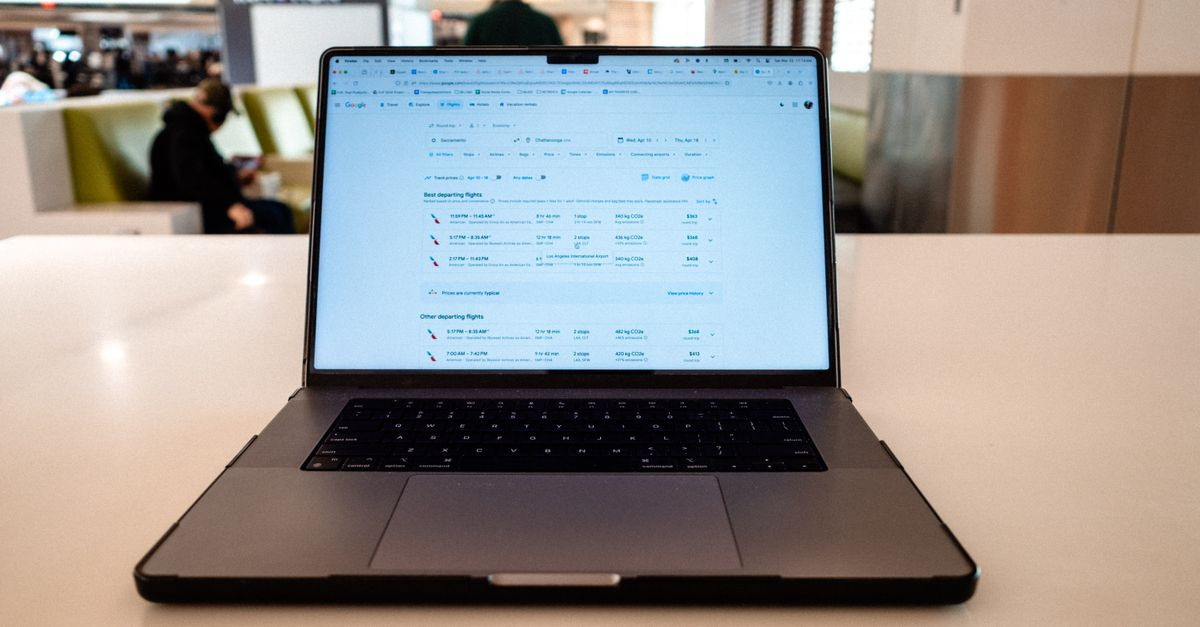
For a business traveler, flexibility is the crucial word. Someone who must arrive in Boston before an 8:30 a.m. meeting and leave after a dinner has far fewer opportunities for savings than someone who can arrive the previous evening, depart from a second nearby airport, or shift the trip by one day. AI becomes more valuable as the number of variables it is allowed to explore grows.
There is also a catch. The lowest fare can involve compromises that are unattractive on a work trip. Google acknowledges that some options in its Cheapest search can involve longer layovers, different airports, self-transfers, or separate tickets purchased from different airlines or booking sites.
That makes the word "cheaper" deceptively complicated. Saving $80 on airfare does not necessarily make sense if the itinerary costs an employee three extra hours, creates more disruption risk, or requires a self-transfer that the company's travel policy discourages. The most useful AI search is therefore one that can optimize for price while respecting limits on stops, times, airports, cabin class, and other practical requirements.
Hotels Are A Much Messier Puzzle
Hotels provide another opportunity for AI, but the pricing problem is more complicated. A single property can appear through the hotel itself, online travel agencies, corporate booking channels, and other distributors, sometimes with different rates or inclusions. Google says its hotel search collects prices from hotel owners, online travel agencies, metasearch companies, and other travel providers, while displayed prices can change quickly.
AI makes comparing that market easier. Google now allows users to search and, for some U.S. properties, complete hotel reservations through AI Mode. Its broader hotel search can compare rates, location, ratings, amenities, and other characteristics, while conventional filters allow travelers to sort by price or narrow results to properties meeting particular requirements.

Price monitoring can help as well. Rather than repeatedly reopening a hotel search before a conference, an automated system can keep watching rates and surface a meaningful change. That matters because hotel prices are dynamic and can move as availability changes.
Yet hotels reveal one of the biggest limitations of AI business-travel shopping. The rate available on the open internet may not be the rate available through a company's negotiated program, and the lowest-looking room may exclude breakfast, flexibility, loyalty benefits, or other items that change its real value.
That problem is widespread enough to concern travel managers. A May 2026 Global Business Travel Association survey of 269 corporate travel buyers in North America and Europe found that 72 percent cited travelers finding cheaper hotel options outside managed channels as a major pain point. The same research emphasized growing interest in booking systems that make the full cost of a stay clearer by showing extras such as breakfast, parking, early check-in, and late checkout during the shopping process.
AI can make those comparisons easier, but only when it has access to the relevant rates and knows what should be included in the calculation.
Business Travel Changes What “Cheap” Means
That distinction separates leisure travel AI from business travel AI. A leisure traveler may simply want the lowest acceptable fare. A company needs to think about negotiated rates, travel policies, cancellation rules, traveler safety, approvals, servicing, expenses, and the cost of employees spending unnecessary hours in transit.

Corporate systems are increasingly building AI around those requirements. SAP Concur, for example, says its AI-enabled Booking Agent can search and compare flights, hotels, and rental cars based on company policies, traveler preferences, and budget requirements. Its Meeting Planning Agent is designed to compare attendee locations, travel costs, schedules, and travel time when recommending where a group should meet.
Those tools show why the biggest AI savings may eventually come from something broader than discovering a slightly lower airfare. If software consistently steers employees toward compliant options, identifies less expensive meeting locations, reduces unnecessary manual work, or catches a suitable fare before it rises, savings can accumulate across an entire travel program.
Businesses have plenty of incentive to look. SAP Concur reported that, based on its global booking data from January through May 2026, average airfare was more than 8 percent higher than during the equivalent 2025 period, while hotel rates were nearly 6 percent higher. Those numbers make small improvements in shopping and policy compliance more financially meaningful.
Still, corporate adoption remains relatively young. GBTA's 2026 research found that 58 percent of travel buyers said AI had made little or no impact on their programs so far, even though 92 percent expressed interest in predictive analytics for travel-spend forecasting and 83 percent were interested in conversational booking.
That gap between interest and actual impact is important. AI travel technology is advancing quickly, but many companies are still figuring out how to connect it to their policies, negotiated rates, data, and existing travel-management systems.
The Best AI Is A Relentless Comparison Shopper
So, can AI actually find cheaper flights and hotels for business travelers? Yes. Its advantage is strongest when it can search live inventory, test more combinations than a busy traveler would reasonably check, watch prices continuously, and understand enough context to distinguish a useful bargain from an impractical one.
What AI cannot do is guarantee that every trip will suddenly become cheaper. The system still searches the fares and room rates available through the sources it can access. A restricted corporate fare, negotiated hotel rate, loyalty benefit, or piece of inventory outside that ecosystem can change which option is genuinely best.
That means business travelers should treat AI as an unusually fast research assistant rather than an unquestionable booking authority. Give it concrete constraints such as meeting times, allowable airports, nonstop requirements, cancellation needs, hotel location, loyalty programs, and corporate spending limits. Then compare the final result with the company's approved booking channel before committing.
The greatest savings may also come from asking AI broader questions. Instead of simply asking for the cheapest flight from New York to London on Tuesday, a traveler could ask whether arriving Monday night would substantially lower the fare, whether another nearby airport offers a reasonable alternative, or whether moving a multi-person meeting to a different city changes the total cost.
That is where AI starts to change business travel rather than merely speeding up an old search box. It can explore possibilities humans often do not have the patience to investigate, while monitoring markets after the initial search is finished.
For business travelers, that makes the technology genuinely useful, but not magical. AI may find a cheaper flight or hotel. The smarter goal is to have it find the lowest-cost trip that still works.
You May Also Like:
Can Sustainable Aviation Fuel Make Business Travel Greener?
The Business Traveler Of 2030 May Never Visit A Check-In Desk
Is The Era Of The One-Day International Business Trip Ending?