
There was a time when being asked to fly somewhere for a meeting felt like a professional privilege. Business travel meant important conversations, valuable connections, and perhaps a decent hotel along the way. But as companies become more careful about spending and employees reconsider how they use their time, a different question is entering the conversation. Is sitting across from someone at a conference table really worth getting on a plane?
The question does not mean business travel is disappearing. The Global Business Travel Association (GBTA) forecasts worldwide business travel spending will reach $1.71 trillion in 2026, a record high. But employees and employers are increasingly distinguishing between trips that accomplish something meaningful and journeys that could have been replaced by a video call.
The Business Trip Is Facing A New Test
For decades, traveling for meetings was an ordinary part of corporate life. Sales representatives visited customers, executives flew between offices, and employees attended conferences to maintain professional relationships. Being physically present was often considered valuable in itself, particularly when important clients or senior leadership were involved. Today, that assumption is receiving closer scrutiny.
The numbers explain why. GBTA's 2026 forecast projects business travel spending will increase 7.2% this year, while the number of trips will grow by only 1.3%. Rising transportation costs are contributing to that difference, meaning companies are spending considerably more without a comparable increase in travel activity. Every journey represents a larger financial commitment.
The shift is also evident in corporate travel research. Deloitte's 2025 Corporate Travel Study found that 54% of surveyed travel managers identified costs among the three biggest factors restricting travel, up from 48% in 2024. Among companies with larger travel budgets, 64% ranked higher prices among their leading constraints. These findings suggest that even organizations committed to in-person interaction are becoming more selective.

Interestingly, the skepticism is not necessarily coming from employees who dislike traveling. SAP Concur's 2025 Global Business Travel Survey found that 94% of business travelers believed work trips were helpful or essential to succeeding in their roles. However, 43% of surveyed chief financial officers believed more than half their company's business travel could be effectively replaced by teleconferencing or other remote communication methods.
That disagreement raises an uncomfortable question about what actually makes a meeting productive. An employee might appreciate visiting another office, but does the visit accomplish anything that could not happen remotely? A manager might prefer discussing an update face-to-face, but is that preference worth several hours of travel? Increasingly, these are the questions that determine whether a trip makes sense.
A One-Hour Meeting Can Consume An Entire Day
The price of an airline ticket represents only part of a business trip's cost. Transportation to airports, security procedures, potential delays, hotel arrangements, and meals all add to the experience. Even a relatively short flight can turn a simple meeting into a substantial commitment of working time. For employees managing demanding schedules, that lost time matters.
Consider the difference between attending a meeting remotely and traveling to another city for the same discussion. The virtual version might occupy a single hour, leaving the rest of the workday available. The in-person version could require an early departure, airport transfers, and a late return home. The meeting itself might be identical, but the demands placed on the employee are dramatically different.

Travel policies can make those demands more complicated. SAP Concur's 2024 survey findings, published in 2025, revealed that 28% of travelers had experienced restrictions on overnight stays intended to avoid exhausting same-day journeys. The same proportion reported cutbacks on paying extra for nonstop flights or more direct routes. Efforts to control spending can therefore make necessary travel less comfortable.
Employee wellbeing is becoming another consideration. SAP Concur's 2026 survey found that 67% of business travelers reported some hesitation about traveling for work, with geopolitical safety concerns and potential disruptions among the reasons. At the same time, 93% said work trips positively affected their mental or physical wellbeing. The findings reveal a complicated relationship rather than a simple rejection of corporate travel.
Employees may enjoy meeting colleagues, visiting customers, and experiencing unfamiliar places while still questioning a particular itinerary. A multi-day conference with valuable networking opportunities offers something different from flying across the country for an internal update. The distinction is important because reducing unnecessary trips does not require eliminating the experiences employees value. It requires examining what each trip actually delivers.
Video Calls Have Changed What Counts As Necessary
The widespread acceptance of virtual meetings has created an alternative to many traditional business trips. Teams can share presentations, review documents, discuss project updates, and make routine decisions without gathering in the same room. That does not make every online meeting effective, but it does make physical travel harder to justify when the agenda is straightforward.
Deloitte's 2024 corporate travel research identified a clear distinction between different reasons for traveling. Conferences, client relationships, and project work remained important drivers of business trips. Meanwhile, spending expectations were weaker for activities that could be more easily replaced by virtual meetings. The findings suggested that digital communication was already influencing corporate travel decisions.
There is still an important argument for meeting in person. Establishing trust with a new customer, negotiating a complicated agreement, or bringing a scattered team together can involve interactions beyond a formal agenda. Informal conversations and spontaneous introductions may create opportunities that were never anticipated when the meeting was scheduled. Those potential benefits help explain why companies continue investing in travel despite technological alternatives.
 LinkedIn Sales Solutions, Unsplash
Deloitte's 2025 study reinforced that distinction. Nearly two-thirds of surveyed business travelers expected to attend a conference that year, making conferences a major reason for traveling. The research also identified stronger demand for employee training and development, with one in five travel managers naming it their company's leading driver of travel growth. These are activities where gathering people together can serve several purposes.
But technology has also altered expectations about how people spend their working hours. Microsoft's 2025 Work Trend Index found that employees in its workplace telemetry analysis were interrupted by a meeting, email, or notification every two minutes on average. That finding speaks to a broader problem of fragmented attention and competing demands. Adding airport journeys to an already crowded schedule can make an ordinary meeting feel disproportionately expensive.
The practical question is therefore not whether in-person meetings are better than virtual ones. It is whether the particular meeting requires the benefits that physical presence can offer. A first introduction to a major client may justify the journey, while a routine presentation may not. Distinguishing between those situations is becoming an important part of responsible business travel planning.
Climate Commitments Are Adding Another Question
Financial costs and employee schedules are not the only considerations. Companies with emissions-reduction commitments must also examine the environmental impact of business flights. Every decision to travel creates another question about whether the expected business benefit justifies the associated emissions. That calculation becomes especially relevant when an effective remote alternative exists.
Deloitte's 2025 research found that 48% of travel managers cited sustainability commitments among their three biggest restrictions on business travel, up from 38% the previous year. The same study found that 45% of respondents believed their organizations needed to reduce travel by at least 20% to meet emissions targets. That was nearly double the 24% reporting such a requirement in 2024.
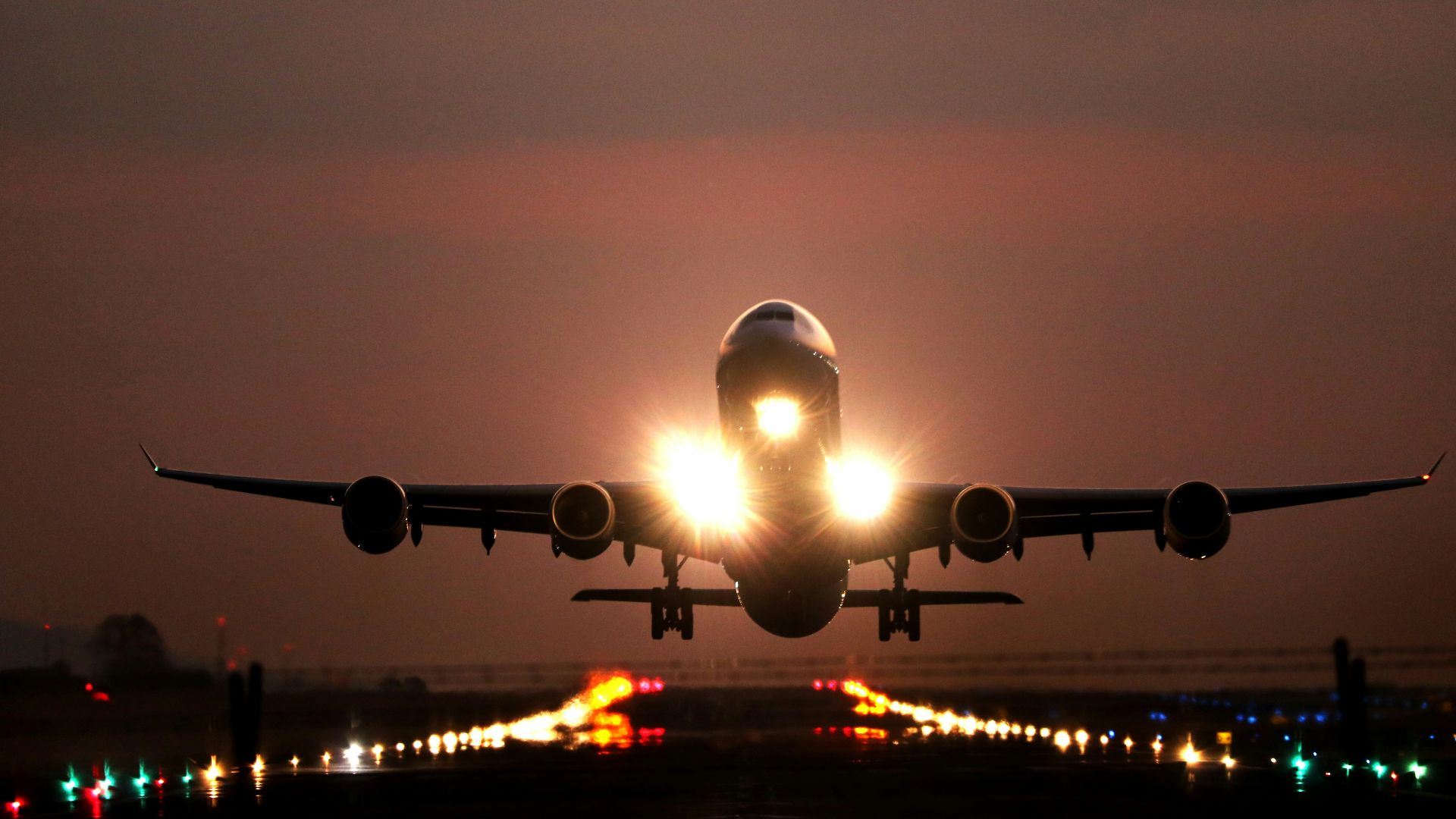
Aviation presents a particularly difficult challenge because cleaner alternatives are still developing. The International Energy Agency's Renewables 2025 report forecast that sustainable aviation fuel consumption would rise substantially through 2030. However, even with that growth, sustainable aviation fuels were expected to meet only about 2% of total aviation fuel demand by the end of the decade. Conventional jet fuel will therefore remain dominant for the foreseeable future.
 Josue Isai Ramos Figueroa, Unsplash
For employers, reducing unnecessary flying offers one way to address travel-related emissions without waiting for new aircraft technology. A company might reserve flights for important relationship-building or essential operational work while conducting routine discussions virtually. For certain journeys, rail travel may also provide an alternative. The appropriate choice depends on the distance, available transportation, and purpose of the trip.
Yet sustainability policies also need to account for fairness and opportunity. Employees whose roles require extensive face-to-face contact cannot necessarily eliminate travel as easily as colleagues whose responsibilities are primarily digital. A universal reduction target could create different consequences across departments. Effective policies need to distinguish between genuinely necessary journeys and those that continue largely because of established habits.
The Future May Belong To Trips That Accomplish More
Instead of choosing between constant travel and no travel, companies can examine what happens during each journey. A visit involving several customer meetings, training sessions, and team discussions may provide greater value than multiple separate trips. Combining objectives can also reduce the number of journeys required. The result is a more deliberate approach to planning.
This approach is consistent with the direction identified in GBTA's 2026 forecast. The association described companies as becoming more selective and productivity-focused, even as overall travel spending continued to grow. Rather than treating the volume of business trips as a measure of success, organizations are paying closer attention to the value each journey creates.
Employees can contribute to that process by asking practical questions before accepting an itinerary. What decision needs to be made, and who must attend in person? Could several meetings be arranged during the same visit? Would a remote discussion produce a comparable result, or is there a specific advantage to gathering physically? These questions encourage better planning without dismissing the importance of personal relationships.
Companies also have an opportunity to rethink how they evaluate travel. A cheaper itinerary is not necessarily better if it produces an exhausting journey or leaves insufficient time for meaningful work. Similarly, approving every trip because it fits an existing budget does not establish that the spending is worthwhile. The stronger measure is whether a journey contributes to a clear business objective.
That may eventually change how employees view business travel itself. The most desirable trips will not necessarily be the most frequent or the most impressive destinations. They may be the ones that offer valuable experiences, strengthen important relationships, and accomplish something that genuinely requires people to be together. Travel can remain a meaningful professional opportunity without becoming an automatic response to every meeting invitation.
Ultimately, questioning whether a meeting is worth a flight is not the same as questioning the value of human connection. It is a recognition that time, money, employee wellbeing, and environmental resources deserve consideration alongside business objectives. Companies still have compelling reasons to bring people together, and employees still have compelling reasons to travel. But in an era when a conversation can happen almost anywhere, getting everyone into the same room increasingly needs a purpose that makes the journey worthwhile.
You May Also Like:
Companies Promised To Cut Business Flights. What Happened?
Is The Era Of The One-Day International Business Trip Ending?
How Companies Are Balancing Business Travel With Climate Commitments