
A flight taken for an employer can feel like work, especially when it consumes an evening or weekend. Under United States wage law, however, inconvenience alone does not determine whether that time must be paid. The answer depends on the employee’s classification, the purpose and timing of the trip, and whether the employee performs work while traveling.
The federal Fair Labor Standards Act provides the main rules for covered employees, but it is only a starting point. State laws, employment contracts, union agreements, and company policies may offer greater protection. Employees must consider all of those factors before deciding whether travel time should appear on a paycheck.
Your Employment Classification Matters
The first question is whether an employee is exempt or nonexempt under wage and hour law. Covered, nonexempt employees generally must receive at least the applicable minimum wage for all compensable hours. They are also usually entitled to overtime under federal law after working more than 40 hours in a workweek.
Exempt employees commonly receive a predetermined salary and do not earn overtime based on each hour worked. Federal regulations generally require an exempt employee to receive the full salary for any week in which that person performs work, regardless of the number of hours involved. An extra evening spent traveling may therefore generate no additional pay, even when the trip is clearly required by the employer.
Being salaried does not automatically make an employee exempt. Department of Labor guidance explains that job titles do not determine exempt status. Most exemptions require employees to meet specific tests involving their compensation and actual duties, so a person called a manager may still qualify for overtime protection.
Company policies can provide more than the law requires. An employer may pay for all business travel, offer compensatory time, or provide additional leave after long trips. A collective bargaining agreement or employment contract may also create rights beyond the federal minimum.
Before a trip, employees should confirm both their legal classification and their employer’s written policy. Two colleagues on the same flight could be covered by different compensation rules because one is exempt and the other is nonexempt. The company may also voluntarily provide benefits that neither employee would receive under federal law alone.
Ordinary Commuting Usually Remains Unpaid
Under federal regulations, normal travel between home and work is generally not working time. This rule usually applies whether an employee reports to one fixed office or travels to different local job sites. A long commute does not automatically become compensable simply because it is inconvenient.
The analysis changes when the employer requires work before the journey. If an employee must report to an office, collect instructions, load essential equipment, or pick up a required vehicle, the subsequent trip to the work site may be part of the workday. Travel from one job site to another after work has started generally must also be counted.
Consider a technician who drives from home to the company’s normal facility. That first journey is usually an unpaid commute. If the technician loads tools there and drives to a customer’s property, the second journey generally counts because the employee has already begun performing principal work activities.
A special one-day assignment in another city follows a different rule. If an employee who normally works at a fixed location must travel elsewhere and return that day, the travel generally counts as working time. The employer may ordinarily subtract the time associated with the employee’s normal commute and any bona fide meal period.
Emergency assignments can also be treated differently from commuting. Federal regulations offer the example of an employee who returns home after work and is later called to travel a substantial distance for an emergency job at a customer’s location. That travel may be compensable because it is undertaken for an unusual employer-directed assignment.
The details matter when an employer provides a vehicle. Merely driving a company vehicle during a normal commute does not always make the trip compensable under federal law. Requirements involving equipment, passengers, preliminary duties, or a mandatory reporting location can change the result.

Overnight Business Trips Follow The Clock
Travel that keeps an employee away from home overnight is generally analyzed according to the employee’s normal working hours. For a covered, nonexempt employee, travel during those hours usually counts as work, even when it occurs on a day the employee ordinarily has off. The employee is effectively substituting travel for normal duties.
Suppose an employee usually works from 9 a.m. to 5 p.m., Monday through Friday. If that employee flies between 10 a.m. and 2 p.m. on Saturday for an overnight assignment, those four hours generally count under the Department of Labor’s enforcement policy. Saturday is normally a day off, but the travel overlaps with the hours regularly worked on other days.
The result may change when an employee travels outside regular hours as a passenger. Under the federal enforcement rule, time spent as a passenger on an airplane, train, boat, bus, or automobile outside normal working hours generally does not have to be counted. A valid meal period may also be excluded when the employee is completely relieved of duties.
Driving receives different treatment because operating a vehicle is an active task. An employee required to drive during a business trip is generally working while behind the wheel. When public transportation is offered but an employee requests permission to drive instead, federal rules may give the employer options for calculating the compensable period.
These distinctions can produce results that seem strange. A nonexempt employee taking an evening flight as a passenger may not be paid for the travel under federal law, while a colleague required to drive during the same period may be entitled to compensation. State law or company policy may provide a more generous answer.
Time zones can add confusion, but the central question remains when the employee traveled relative to regular working hours. Employees should record the actual duration of the trip and identify the normal schedule that applies. They should not rely only on the local clock shown at the departure or arrival airport.
Working While Traveling Still Counts
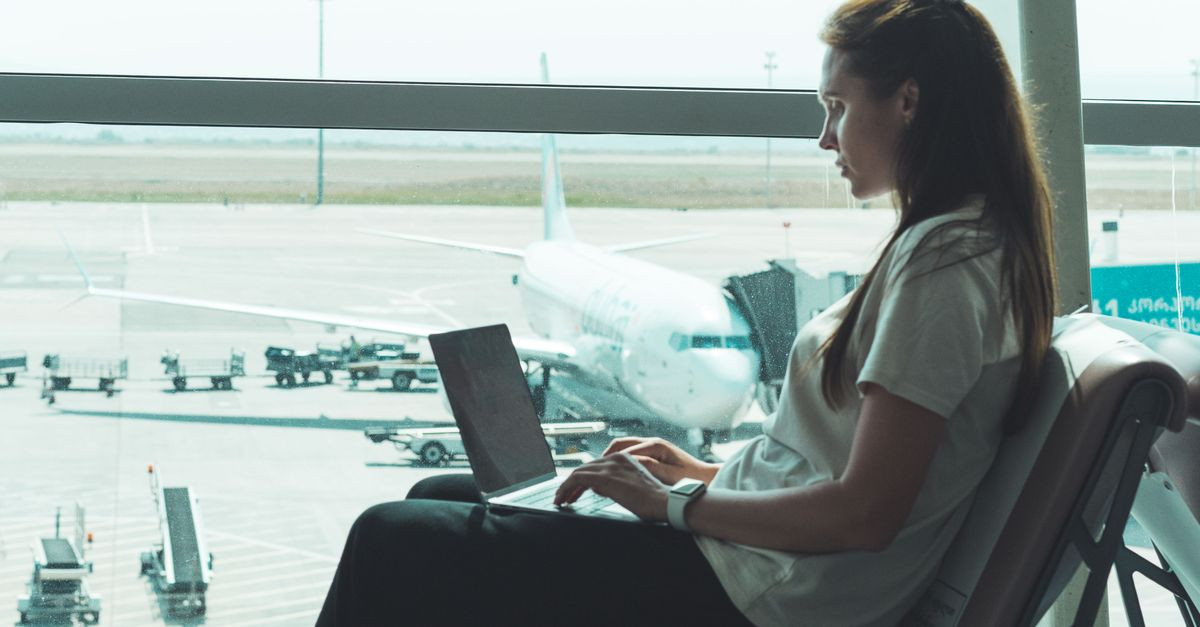
Travel does not become personal time simply because an employee is sitting in an airport or on a train. Federal regulations state that work an employee is required to perform while traveling must be counted. Preparing a presentation, answering required emails, writing reports, or joining a conference call can make otherwise unpaid travel compensable for a nonexempt employee.
The same principle can apply when a manager knows work is being performed and allows it to continue. Department of Labor guidance says work that is permitted must generally be counted, even when the employer did not formally request it. A company cannot accept the benefit of an employee’s work while refusing to record the time.
Employers can still establish scheduling rules and require approval before an employee works overtime. Breaking an approval rule may expose an employee to discipline, but it does not necessarily eliminate the employer’s obligation to pay for work it knew was performed. Employees should follow the policy while accurately reporting all working time.
Waiting during a trip requires a fact-specific analysis. A traveler free to use a lengthy delay for personal activities may be treated differently from someone required to monitor arrangements, guard equipment, remain available for immediate instructions, or continue working. The question is whether the employee can genuinely use that period for personal purposes.
Meal periods involve a similar distinction. A bona fide meal period generally does not have to be counted when the employee is fully relieved of duties. If the traveler must answer calls, watch company property, or hold a working lunch, that time may remain compensable.
Airport security and check-in time can be harder to classify because the federal overnight-travel rules focus heavily on normal working hours and the employee’s duties. Employees should record the entire journey rather than deciding for themselves which minutes count. Payroll or a labor agency can then assess the complete facts.

Records And Local Laws Can Change The Outcome
Federal law establishes minimum nationwide standards, but state and local rules may be more protective. The Department of Labor notes that employers must comply with applicable laws offering greater employee protections. Workers should check the rules where they are employed and seek guidance when a trip involves several jurisdictions.
Travel pay and expense reimbursement are separate questions. Reimbursement for airfare, hotels, meals, mileage, or taxis does not necessarily mean the travel hours were properly counted. Likewise, treating a journey as working time does not automatically settle which expenses must be reimbursed under a particular state law or employer policy.
Accurate records become crucial when pay is disputed. Employers covered by federal recordkeeping requirements must maintain specified information about nonexempt employees’ hours and wages. Employees can still protect themselves by keeping contemporaneous notes of departure times, arrivals, delays, driving, assigned tasks, meal periods, and management instructions.
A calendar entry or boarding pass may establish when a trip occurred, but it may not show when work was performed. Employees should note when they answered messages, prepared documents, attended calls, or transported equipment. They should also save relevant schedules and written travel instructions.
When something looks wrong, employees can begin by reviewing the travel policy and asking payroll, human resources, or a manager for an explanation. A useful written question identifies the trip, normal work schedule, disputed travel period, and any duties performed. This gives the employer enough information to investigate the issue rather than responding to a vague complaint.
If the problem remains unresolved, the Department of Labor’s Wage and Hour Division accepts complaints involving pay and overtime. A state labor agency or employment lawyer may be appropriate when local law applies or substantial wages are involved. Employees should seek individualized advice because small factual differences can change the legal outcome.
So, should travel time count as work time? In many situations, yes, but federal law does not treat every work-related journey the same way. Ordinary commuting is usually unpaid, while travel between job sites, certain special assignments, required driving, travel during normal working hours, and duties performed in transit may be compensable.
The best protection is preparation. Employees should understand their classification, request the company’s policy before traveling, keep detailed records, and raise questions promptly. A business trip should not require anyone to guess which hours belong on the timesheet.