
The pool turned green halfway through our stay. We complained and the man at the desk said, "You can still swim, it's fine." Can we demand a refund?

The pool turned green halfway through our stay. We complained and the man at the desk said, "You can still swim, it's fine." Can we demand a refund?


February 13, 2026 | Marlon Wright

The pool turned green halfway through our stay. We complained and the man at the desk said, "You can still swim, it's fine." Can we demand a refund?


Pool turned greenFactinate

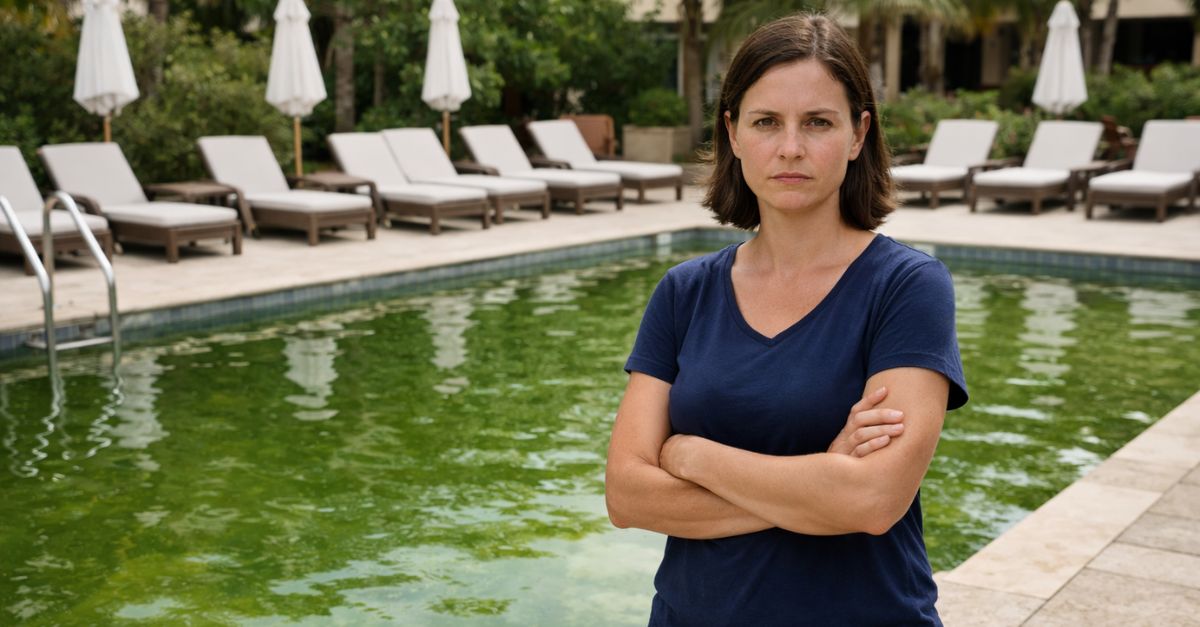
The resort brochure had promised crystal-clear water, a peaceful deck lined with loungers, and the kind of pool that becomes the center of every vacation memory. For the first few days, that promise held true. Then one morning, the water shifted to a murky green, with faint streaks of algae clinging to the sides. Staff continued to allow guests to swim, offering vague reassurances that chemicals would be added later. Situations like this can fall into a gray area between poor service and potential health code violations. Understanding where inconvenience ends and legal responsibility begins is the first step toward protecting both health and money.

When A Hotel’s Pool Crosses Into A Safety Issue

In most US states, pools are regulated by local health departments, which require specific chlorine levels and regular inspections. A green pool almost always signals a lapse in these requirements. Algae growth occurs when disinfectant levels drop too low or circulation fails, which then allows bacteria to multiply. This can expose swimmers to pathogens that cause rashes and gastrointestinal illness, and these are just a few of the issues. When a hotel knowingly keeps such a pool open, it may be violating public health codes. That matters because once safety regulations are breached, the issue shifts from inconvenience to negligence. 

Most hotel stays are governed by basic contract principles: guests pay for a room and the services advertised with it. If a resort heavily promotes its pool as part of the experience, that feature becomes part of what was purchased, as it helps in choosing to stay there over other available options. When it becomes unusable, the hotel may have failed to deliver what was promised. Many states also have consumer protection or “unfair trade practices” laws that prohibit businesses from misrepresenting services. Advertising a pristine pool while allowing guests to swim in green water could fall under misleading business practices.

Timing also plays a crucial role. Addressing the problem immediately increases the likelihood of resolution. If you wait until checkout, it can weaken claims, as hotels may argue they weren’t given a chance to fix the issue. Keep communication professional and factual, as it helps avoid dismissal as an emotional complaint. When pursuing compensation, evidence is critical. Photos and videos of the pool’s condition, along with timestamps and written communication with staff, create a record that shows the problem wasn’t minor or imaginary. If management dismissed concerns or refused to close the pool, that response matters. Written complaints through email or the hotel’s official app can carry more weight than verbal conversations. Should the situation escalate to a formal dispute or small claims court, this documentation can demonstrate both the severity of the issue and the hotel’s failure to correct it even after repeated requests.
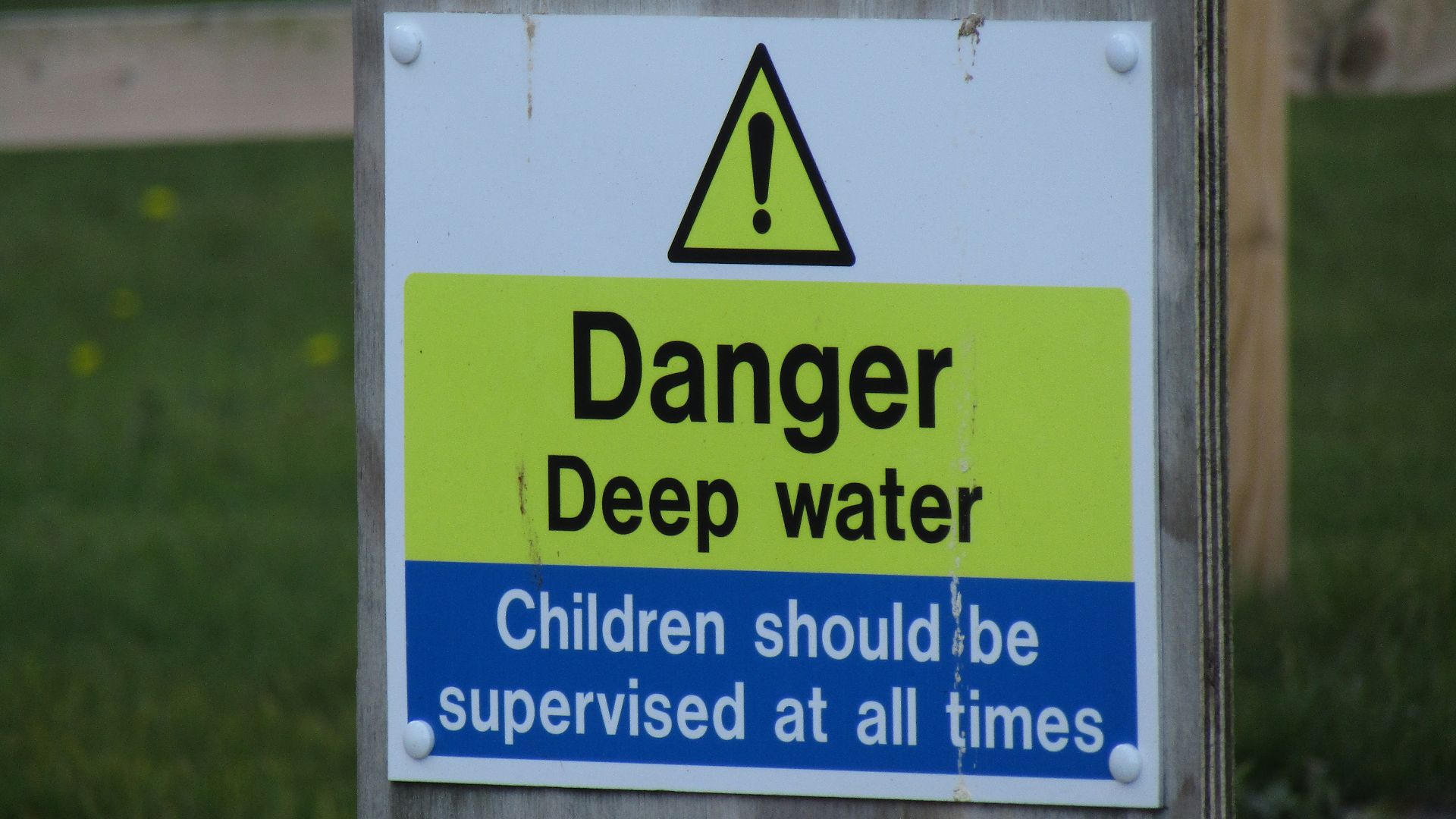
File:-2018-10-11 Sign, Derelict swimming pool, former Grand Hotel, Mundesley.JPGKolforn (Kolforn) I'd appreciate if you could mail me ([email protected]) if you want to use this picture out of the Wikimedia project scope. This file is licensed under the Creative Commons Attribution-Share Alike 4.0 International license. You are free: to share – to copy, distribute and transmit the work to remix – to adapt the work Under the following conditions: attribution – You must give appropriate credit, provide a link to the license, and indicate if changes were made. You may do so in any reasonable manner, but not in any way that suggests the licensor endorses you or your use. share alike – If you remix, transform, or build upon the material, you must distribute your contributions under the same or compatible license as the original.https://creativecommons.org/licenses/by-sa/4.0CC BY-SA 4.0 Creative Commons Attribution-Share Alike 4.0 truetrue, Wikimedia Commons

Advertisement

Financial Routes That Often Work Faster Than Legal Action

While lawsuits are possible, most travelers find faster resolution through financial channels. Speaking directly with hotel management remains the first and often most effective step. Hotels typically have the authority to issue partial refunds or credit future stays to avoid bad publicity and formal complaints. If management refuses to help, credit card chargebacks become a powerful tool. Federal consumer protections allow cardholders to dispute charges for services not delivered as agreed. Many card issuers side with consumers in situations involving misrepresentation or health concerns. Similarly, online booking platforms frequently offer mediation services that can pressure hotels into issuing refunds or credits, especially when evidence shows a serious service failure.

Escalation Options When Hotels Won’t Cooperate

Local health departments take reports of contaminated pools seriously. If you file a complaint with them, it can trigger inspections and potential fines, which hotels often want to avoid. For monetary recovery, small claims court remains an option in many states for disputes under a certain dollar amount. These courts are designed for individuals to represent themselves without lawyers. Guests can argue breach of contract, supported by evidence showing the pool’s condition and the hotel’s inaction. While this route requires time and effort, it can result in partial or full refunds when other methods fail. Often, simply notifying a hotel of intent to pursue formal complaints or legal claims can motivate quicker settlement.

man in black long sleeve shirt using macbookChristian Velitchkov, Unsplash

Advertisement

READ MORE

Image of a turkish american man with a map of south carolina

A man named Yusef ben Ali fled the Ottoman Empire and fought in the American Revolution. The Turks of South Carolina have lived there ever since.

History is full of secrets and surprises. As time wears on and stories become facts the truth becomes muddled. For years, people doubted the origins of the mysterious “Turks” of South Carolina. However, the truth is far more interesting than the story could ever tell.
February 13, 2026 Jillian Kent
Man standing near a granite wall

Tourists visiting Montana's Sage Wall can not believe its massive, geometric granite blocks could have occurred naturally.

Something strange rises from a Montana mountainside. Granite blocks stack in patterns that look unnervingly deliberate. The formation predates human existence, yet visitors can't shake the feeling they're staring at ancient architecture.
February 13, 2026 Miles Brucker
Resort pool negligence

The pool turned green halfway through our stay. We complained and the man at the desk said, "You can still swim, it's fine." Can we demand a refund?

The resort brochure had promised crystal-clear water, a peaceful deck lined with loungers, and the kind of pool that becomes the center of every vacation memory. For the first few days, that promise held true. Then one morning, the water shifted to a murky green, with faint streaks of algae clinging to the sides. Staff continued to allow guests to swim, offering vague reassurances that chemicals would be added later. Situations like this can fall into a gray area between poor service and potential health code violations. Understanding where inconvenience ends and legal responsibility begins is the first step toward protecting both health and money.
February 13, 2026 Marlon Wright
Yellowstone - Fb

Research of the Yellowstone caldera is limited and extraction is outright banned, but some scientists suggest there's up to $680B in resources within.

Beneath Yellowstone National Park’s geysers and trails, scientists are studying an ancient volcanic system tied to immense underground energy. It raises questions about the various ways we can harness the energy in future discoveries.
February 13, 2026 Marlon Wright
Greek Archaeologists

Greek writers told us where to find the Sanctuary of Artemis. It took 200 years, but modern methods finally found the site, and it is spectacular.

Beneath quiet farmland and modern homes, a buried sanctuary waited thousands of years, preserving clues to forgotten ceremonies, distant trade, and sacred traditions that reshaped what scholars thought they knew about early Greek worship history.
February 13, 2026 Peter Kinney
Synagogue at Capernaum

Researchers in Israel are confident they found a synagogue where Jesus performed miracles, complete with graffiti that refers to Christ himself.

Along Israel's northern shore, white limestone columns rise from ancient ruins. Beneath this visible fourth-century synagogue lies a black basalt foundation from the first century. Archaeologists believe it witnessed Jesus performing miracles nearly 2,000 years ago.
February 13, 2026 Marlon Wright