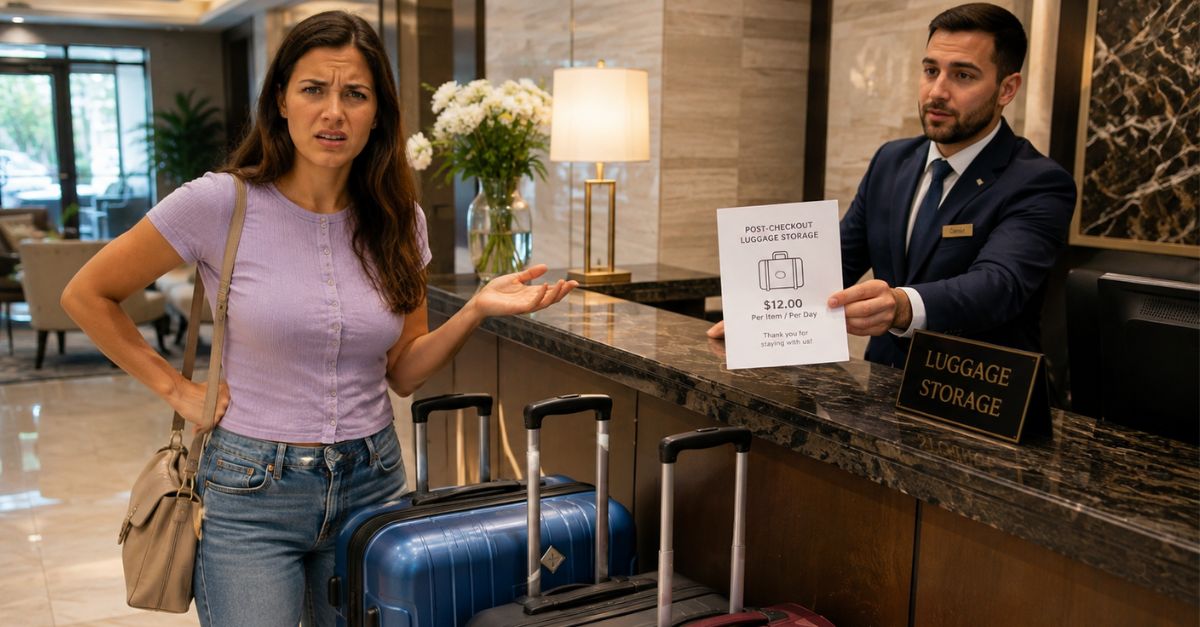
The New Checkout Sting
You check out, take one last walk, and then the front desk hits you with a surprise. Leaving your bags behind now comes with a fee. For travelers who long saw post-checkout luggage storage as a basic courtesy, that moment can feel like a small bait and switch.
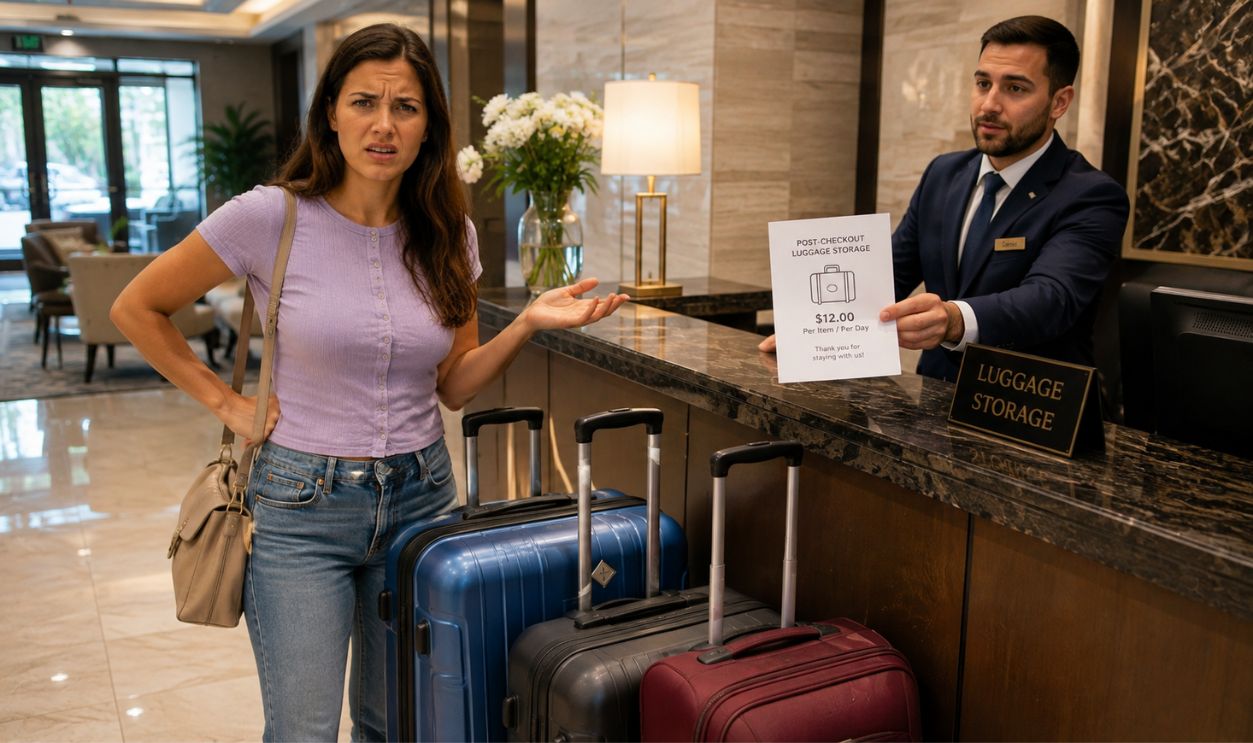
A Small Fee That Feels Bigger
The charge is usually not huge, but it shows up at exactly the wrong time. Travelers are already dealing with late flights, train schedules, and that awkward stretch between checkout and departure. What used to be a simple hotel favor is more often being treated as a separate service.

Why This Question Keeps Coming Up
The frustration makes sense because hotels have never handled luggage storage the same way. Some still hold bags for free before check-in and after checkout. Others now limit the service, hand it off to partners, or charge for it, especially in busy city centers where space is tight.

What The Big Hotel Guidance Actually Says
Major hotel brands often list luggage storage as an available service, but not always as a guaranteed free perk. Hilton hotel pages list luggage hold among services at some properties, while Marriott amenity pages often note baggage storage depending on the location. The important detail is that these listings usually describe availability, not a blanket promise that every guest gets it for free.

Not Every Hotel Means The Same Thing
That is where a lot of the confusion starts. A traveler may reasonably think “baggage storage available” means free storage after checkout. A hotel may mean it can hold bags only in certain cases, for limited hours, or with a fee attached.

The Fine Print Is Doing More Work Now
Online booking pages increasingly push travelers to check property-specific details before arrival. That matters because the policy can vary not just by brand, but by individual hotel. In practice, the luggage rule at one downtown branch may be very different from the rule at another hotel under the same brand.

Space Has Become A Real Problem
One big reason is simple logistics. Hotels in dense urban areas often have tiny back offices and limited secure storage rooms. As occupancy rises and more guests show up early or leave late, bag rooms can fill up fast.

Security Is Part Of The Story Too
Hotels also have to think about what they are agreeing to hold. Unattended luggage creates obvious security concerns, and properties may want stricter labeling, time limits, or waivers. Charging a fee can be one way to limit demand and justify the staff time needed to manage the risk.

The Outsourcing Trend Is Hard To Miss
Another shift is that travelers no longer have to rely only on hotels. Dedicated luggage storage networks such as Bounce, LuggageHero, and Stasher have built businesses around hourly or daily bag storage in hotels, shops, and other partner locations. Their growth suggests there is now a real market for a service many people once expected hotels to provide for free.

Bounce Turned A Courtesy Into A Category
Bounce, founded in 2018, markets itself as a luggage storage network for travelers who need flexibility between check-in and checkout. Its service lets users book storage in cities around the world for a set fee. The company’s very existence says a lot, because a problem once handled informally by hotels is now being sold as part of travel infrastructure.

LuggageHero Built Around The In Between Hours
LuggageHero launched earlier, in 2016, and focuses on short-term storage through local partners. Its pitch is built around the exact problem travelers face after checking out and before heading to the airport. If businesses can reliably charge for that gap, it is a sign that free hotel storage is no longer something travelers should assume.
 veerasak Piyawatanakul, Pexels
Stasher Saw The Same Opening
Stasher, founded in 2015, also expanded by partnering with hotels and local businesses to store bags for a fee. The company presents luggage storage as a practical travel fix rather than a luxury add-on. That wording reflects a broader shift in tourism, where convenience services that once came bundled with accommodation are increasingly sold separately.

Air Travel May Be Nudging This Change
Airlines have spent years getting travelers used to extra charges for things once seen as basic, from checked bags to seat selection. Travelers now run into fee-based pricing across the whole trip, and hotels operate in that same environment. Hotel luggage storage is not directly tied to airline policy, but the wider travel economy has clearly become more pay-as-you-go.

Hotels Are Also Selling More Add Ons
Industry groups such as the American Hotel & Lodging Association regularly point to ancillary revenue as part of hotel operations. That can include parking, late checkout, food packages, and other extras that help properties make money beyond the room rate. A luggage hold fee fits neatly into that model, especially at hotels with heavy turnover.

Late Checkout Became More Valuable
There is another subtle reason free bag storage may be under pressure. Hotels can make money from late checkout directly, giving guests the option to keep the room instead of just leaving bags downstairs. If a property can sell extra time in the room, it may have less reason to offer a free alternative.

Labor Costs Matter At The Front Desk
Bag storage sounds simple until the lobby gets crowded. Staff have to tag items, place them securely, retrieve them later, and deal with complaints if something goes missing. In an era of tighter staffing and rising labor costs, hotels may see this as a service that should not be free by default.

Liability Is A Quiet Factor
Hotels post disclaimers around stored property for a reason. Once staff take possession of luggage, questions about damage, theft, and responsibility can get messy. Charging for the service may not remove liability, but it can push hotels toward clearer procedures and tighter terms.

Luxury Hotels Are Not Always The Exception
Many upscale properties still hold bags without charge as part of a more hands-on guest experience. But even a luxury brand does not guarantee the same treatment everywhere. Ownership, local space limits, and operating rules can all affect whether storage stays a free courtesy.
 Tongpool Piasupun, Shutterstock
Budget Hotels May Be Stricter
At the lower end of the market, there is often less room to absorb extra labor and storage costs. Smaller properties may not have a dedicated luggage room at all. In those cases, refusing bags or charging a fee can be less about greed and more about limited capacity.

Vacation Rentals Changed Expectations Too
The rise of short-term rentals has also created more demand for independent luggage storage services. Apartment hosts usually cannot offer a staffed bag room after checkout. As that kind of accommodation expanded, companies offering paid bag storage stepped in and helped normalize the idea that this convenience might cost extra.

There Is Still No Universal Rule
That is the key point for travelers. There is no single industry-wide standard requiring hotels to store your luggage for free after checkout. Policies remain highly specific to each property, and the safest assumption is that availability, timing, and price can vary.

Consumer Advice Starts Before You Arrive
If you know you will have a late departure, contact the hotel before booking or before arrival. Ask whether they store bags after checkout, whether it is free, and whether there is a time limit. Getting the answer in writing through email or app messaging is even better.

Look Closely At The Amenity Page
Do not rely only on broad brand promises or old reviews. Check the exact property page for terms like baggage storage, luggage hold, concierge, and late checkout. If the website is vague, take that as a sign to ask directly instead of assuming the service is included.
 Christian Velitchkov, Unsplash
Be Ready With A Backup Plan
If the hotel says no or quotes a fee you do not want to pay, nearby paid storage may still save the day. Bounce, LuggageHero, and Stasher all let travelers compare locations and prices in advance. In large cities and transit hubs, those options can be easier than arguing with the front desk.

When A Fee May Actually Be Worth It
Not every luggage fee is unreasonable. If the hotel offers secure storage, staffed retrieval, and a location steps from your room, paying a small amount may beat dragging bags across the city. The real irritation usually comes when travelers expected a basic courtesy and got blindsided at checkout.

The Best Way To Avoid The Surprise
Treat luggage storage the same way you now treat parking, breakfast, and resort fees. Check it before you go. The era when many travelers could safely assume post-checkout bag storage was free looks a lot less reliable now.

So Is Basic Luggage Storage Disappearing
Not entirely, but the old assumption is clearly weakening. Free hotel luggage storage still exists at many properties, yet it is becoming more inconsistent, more limited, or replaced by paid alternatives. For travelers, the takeaway is simple: what once felt basic now needs to be confirmed like any other hotel perk.
 Hryshchyshen Serhii, Shutterstock