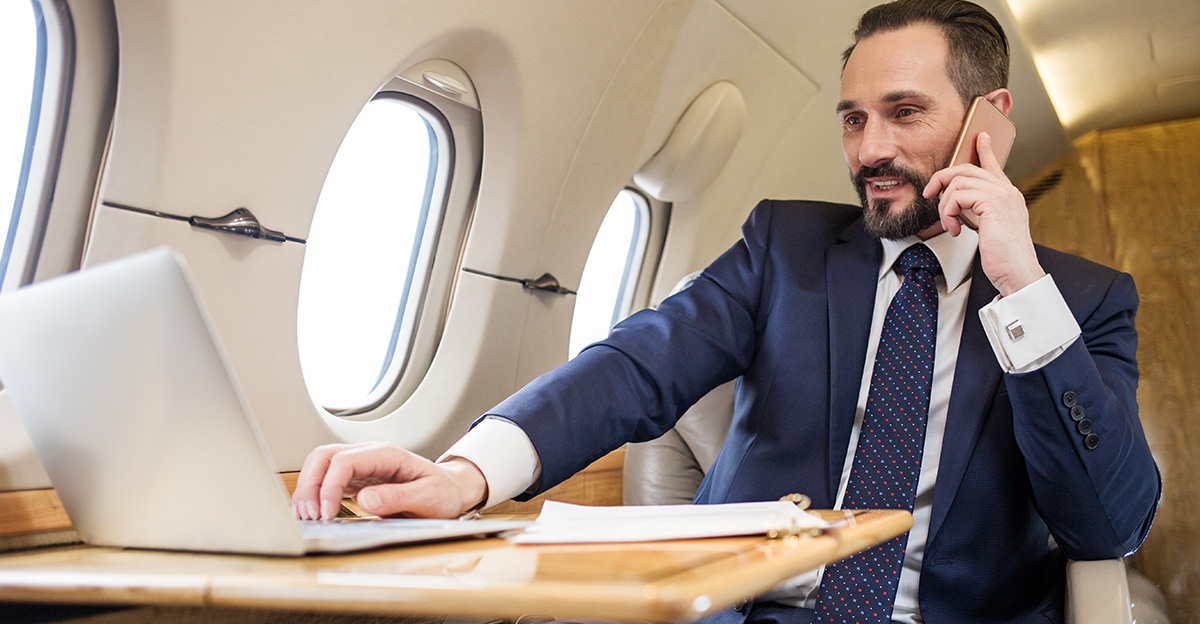
The $2,000 Meeting: How Companies Decide Whether A Business Trip Is Worth The Money
A flight, two hotel nights, airport transportation, meals, and a few incidental expenses can turn an ordinary business meeting into a surprisingly expensive calendar appointment. That problem is becoming harder for companies to ignore. The Global Business Travel Association forecasts worldwide business travel spending of $1.71 trillion in 2026, up 7.2% from 2025, while the total number of business trips is expected to increase just 1.3%. In other words, companies are spending considerably more without sending employees on dramatically more trips.
That is why the modern travel-approval conversation increasingly starts with a different question. Instead of asking whether somebody wants to attend a meeting, companies want to know what is supposed to happen because that person attends. Deloitte's 2025 Corporate Travel Study found that 58% of surveyed companies prioritized trips that could lead to specific business outcomes, while 54% conducted pre-trip assessments of whether individual journeys were justified.
The Plane Ticket Is Only The Beginning
The sticker price of a flight rarely represents the complete cost of sending someone somewhere. GBTA's 2027 Global Business Travel Forecast, published in July 2026, projects the average global airfare at $756 in 2026 and the average hotel daily rate at $168. Premium airfares are substantially higher, with GBTA forecasting an average of $4,488 across premium economy, business, and first-class travel.
Companies also have to account for meals, local transportation, meeting expenses, and whatever rules their travel policy permits. GBTA's 2026 study of corporate travel policies in the United States and Canada found that 75% of surveyed companies imposed either meal per diems or spending limits. Only 30% used hotel per diems or rate caps, while 46% simply instructed employees to book a reasonably priced hotel.
That means a "$2,000 meeting" is not a particularly exotic idea once the entire trip is considered. The exact total depends heavily on destination, distance, trip length, fare class, and company policy, but higher transportation costs are already having a noticeable effect on corporate budgets. GBTA expects global travel spending to rise much faster than trip volume in 2026, a gap it attributes in part to elevated transportation and travel prices.
There is another expense that does not appear neatly beside the hotel bill: employee time. A traveler may spend hours getting to an airport, flying, checking into a hotel, attending a meeting, and returning home. Companies therefore have good reason to consider whether the purpose of that travel justifies taking an employee away from other work, especially when the meeting could potentially happen remotely.
The Real Question Is What Happens After The Meeting
Companies cannot evaluate every trip using exactly the same yardstick. A salesperson flying to meet a prospective customer may be trying to advance a deal. An account manager may be protecting an existing client relationship, while an engineer visiting a factory may need to solve a problem that cannot easily be diagnosed through a video call.
Deloitte's research shows that external relationships remain a major reason companies travel. Its 2025 study found new business initiatives were the most frequently cited driver of travel growth among surveyed travel managers, followed closely by training and development and increased face-to-face engagement with clients, partners, and vendors. Nearly two-thirds of the business travelers surveyed also expected to attend a conference during the year.

That creates a simple but important distinction. The financial case for spending $2,000 to meet a prospect connected to a significant sales opportunity is different from spending $2,000 so two colleagues can have a routine discussion they normally hold online. Companies increasingly try to connect trips with outcomes such as customer engagement, business development, training, or event participation rather than treating all travel as equally valuable. Deloitte found that most surveyed organizations were still making these kinds of pre-trip assessments in 2025.
The calculation also does not always end when the traveler returns home. Some benefits, particularly relationship building or employee development, may emerge over months rather than appear on the next expense report. That helps explain why organizations can use both financial measures and broader strategic goals when setting travel budgets rather than demanding immediate revenue from every journey.
Not Every Trip Needs To Produce A Purchase Order
Sales travel is naturally easier to connect to money because companies can compare travel spending with leads, contracts, renewals, or revenue. Other travel categories are more complicated. Training trips, conferences, supplier meetings, internal gatherings, and site visits can have valuable purposes even when nobody signs a contract at the end of the day.
Deloitte found training and development becoming an especially important travel driver in 2025. Twenty percent of the travel managers it surveyed named training as their company's leading reason for travel growth, and 49% of surveyed travelers had already traveled or expected to travel for training during the year. Live events also remained significant, with 65% expecting to attend a conference.
Corporate travel research nevertheless suggests that companies have strong incentives to manage travel strategically instead of simply cutting it. A 2025 benchmarking study from GBTA and the American Society of Travel Advisors analyzed data from more than 3,200 U.S. companies and reported an association between higher managed travel spending and higher revenue. The study's econometric model found that every 1% increase in managed travel spending was associated with a 0.20% rise in revenue, although the results concern company-wide travel investment rather than proving that any individual $2,000 trip will pay for itself.
The same research emphasized balance. GBTA and ASTA reported that companies with strategically governed travel programs performed better in their model, but they also warned that policies could become so rigid that employees lose the flexibility needed to make timely or cost-effective travel decisions. That makes travel management less about automatically saying yes or no and more about determining where spending is likely to be useful.
The Approval Process Is Getting Smarter
For travelers, the approval system can sometimes feel as if somebody in finance is standing between them and the boarding gate. In reality, corporate travel policies have been tightening in many organizations. GBTA's March 2026 survey of 168 travel managers in the United States and Canada found that 32% said their travel policies were stricter than three years earlier, while only 5% reported that policies had become more lenient.

Companies are also trying to gain better visibility over what employees actually spend. Booking outside required corporate channels was the largest compliance problem in that GBTA survey, cited by 35% of respondents. Twenty-eight percent specifically identified out-of-policy hotel bookings as a major challenge.
Technology is beginning to change how those decisions are made. GBTA's 2026 research on business travel technology found that 92% of surveyed travel buyers were interested in predictive analytics for forecasting travel spending, while 89% were interested in automated disruption management and rebooking. Yet adoption remains uneven: 58% said AI had made little or no impact on their travel programs so far, and only 12% had a consolidated view of their program from a single data source.
That gap matters because better data can make the $2,000-meeting question much more precise. Instead of relying solely on a manager's instinct, a company can compare proposed spending with past trips, negotiated rates, department budgets, travel patterns, and actual results. AI may make some of those comparisons faster, but current GBTA data suggests human judgment is still very much part of corporate travel management.

Sometimes The Most Expensive Meeting Is The One You Skip
Cost pressure does not mean companies have stopped believing in travel. GBTA expects 1.84 billion business trips worldwide in 2026, and 65% of travelers in its latest Business Travel Index survey said their companies required or encouraged booking through managed travel programs. The industry is still enormous, but the emphasis is increasingly on being selective about where people go and why.
Deloitte's research captures that tension clearly. Seventy-four percent of travel managers surveyed in 2025 said their budgets were expanding, yet 54% also listed cost among the three biggest factors restricting travel. Larger corporate travel programs showed even more caution, with one in five surveyed companies spending at least $7.5 million annually on travel expecting their budgets to decline in 2025.
For the traveler, that can make the approval process feel tougher than it was a few years ago. For the company, however, the goal is not necessarily to eliminate expensive trips. It is to avoid paying for expensive trips whose purpose is vague, whose outcome could reasonably be achieved online, or whose cost is difficult to defend against other business priorities.
A $2,000 meeting can therefore be either an obvious waste or a bargain. A face-to-face conversation that advances a major account, brings several customers together at one conference, trains an important team, or solves an operational problem may justify the spending. A routine update involving people who already work together may struggle to clear the same bar. The most important number is no longer simply the fare on the booking screen. It is the value the company expects to receive after the traveler comes home.