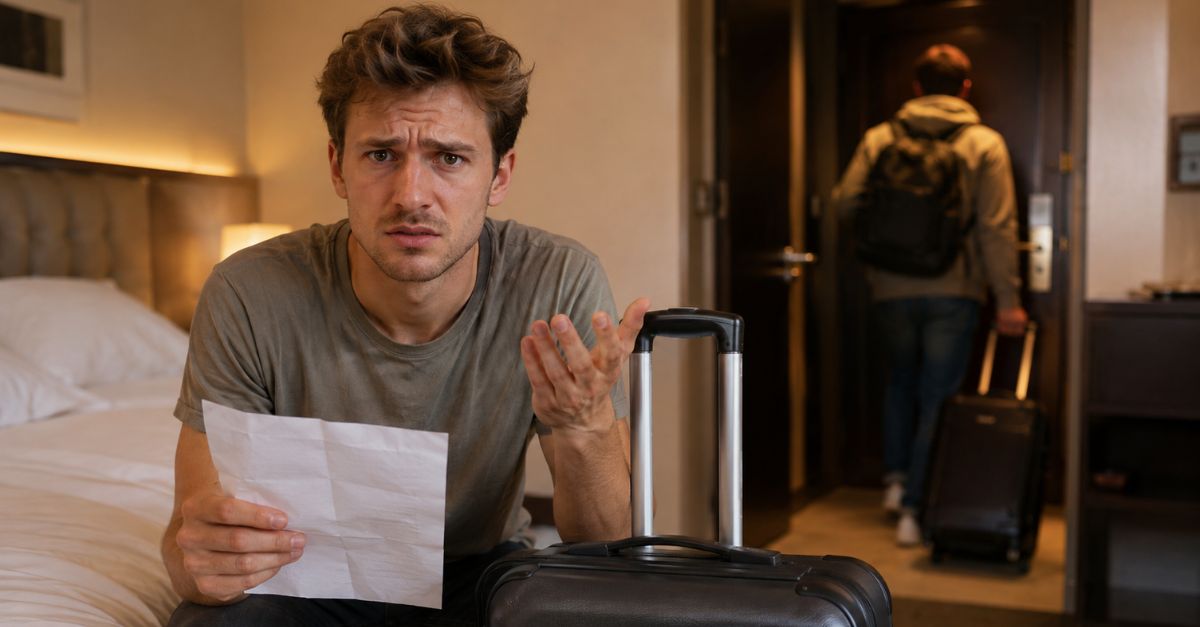
The Vanishing Travel Buddy Problem
It sounds like the start of a bad travel story. You split a hotel room with a friend, partner, or travel buddy, then they vanish for two days and leave you stuck with the bill. The good news is that this is usually a money dispute, not a legal mystery, and there are practical ways to handle it.

Start With The Hotel Rules
Your first step is the hotel’s terms and the reservation details. In most cases, the hotel can collect payment from the guest whose name is on the booking or whose card was used to hold the room. That means the hotel may not care that your travel buddy said they would pay half.

Why The Hotel Still Wants Full Payment
Hotels usually deal with the person who made the reservation, not private agreements between travelers. If only your name is on the booking, the hotel can normally expect you to pay for the full stay. That is true even if someone else stayed in the room and agreed out loud to split the cost.
The Key Distinction That Changes Everything
There are really two separate issues here. One is what you owe the hotel under the reservation terms. The other is whether you can get your travel buddy to pay you back afterward.

What Federal Consumer Guidance Says
The Consumer Financial Protection Bureau says consumers can dispute credit card charges for billing errors and for charges for goods or services not accepted or not delivered as agreed under the Fair Credit Billing Act. That can help in some travel situations, but it usually does not wipe away a valid hotel charge just because your roommate bailed. If the room was provided and the reservation was legitimate, your fight with your buddy is usually separate from your fight with the hotel.

When A Credit Card Dispute Might Work
A card dispute may still make sense if the hotel charged more than the rate you agreed to, billed extra nights you did not approve, or added damages or incidentals by mistake. The CFPB notes that timing matters, and billing error rights have deadlines. Keep your folio, booking confirmation, and any checkout paperwork.

When A Credit Card Dispute Probably Will Not Work
If the hotel charged correctly for the room you used, your card issuer may reject a dispute based only on your travel buddy refusing to reimburse you. Card issuers usually look at whether the merchant billed properly, not whether your friend broke a promise. That is frustrating, but it is common.

Do Not Ignore The Bill
It may be tempting to walk away and hope the card issuer sorts it out. That is risky. Unpaid hotel bills can be sent to collections, and that can turn an annoying split-cost problem into a much bigger mess.

Gather Proof Before Memories Get Fuzzy
Save text messages, emails, booking screenshots, and payment app requests that show you both agreed to share the room. If your buddy asked you to put the room on your card and promised to pay you back, that matters. Those records can help in negotiations and, if needed, in court.

Get The Folio And Reservation Record
Ask the hotel for the final folio and confirmation showing the dates, room rate, taxes, and any incidentals. Also ask whose names were attached to the reservation and whether both guests checked in. Those details can help show that your travel buddy benefited from the stay.

A Quiet Clue That Can Help Your Case
If your buddy used the room key, appeared on hotel records, or was listed as an extra guest, that can support your claim that they shared the room and should share the cost. It does not force the hotel to split the bill, but it may help you show that your reimbursement request is fair and backed by facts.

Ask For Reimbursement In Writing
Before jumping into legal action, send a calm written demand. List the dates of the stay, the total bill, the amount you paid, and the amount you think they owe. Give a reasonable deadline and keep the tone polite. A clear message often works better than an angry one.

Why Written Demands Matter
A written request creates a timeline. If the dispute gets worse, you can show that you tried to work it out first. Judges and mediators often like seeing that kind of paper trail.

Think About Small Claims Court
If your travel buddy refuses to pay, small claims court is often the most practical option. The American Bar Association says small claims courts are meant for straightforward disputes involving limited amounts of money, and the process is simpler than in higher courts. The exact filing limits and rules depend on the state.

What You Need For Small Claims
Bring the reservation confirmation, hotel folio, your card statement, messages showing the cost-sharing agreement, and proof that your buddy stayed there. You are trying to tell a simple story: you paid the full amount, they agreed to share it, and they never paid you back.

The Dollar Limit Depends On Where You File
Small claims limits are not the same everywhere. Nolo’s state-by-state guide shows that maximum claim amounts vary a lot by state. Before filing, check the rules in the state and county where the case should be brought.

Where You Might Need To File
The right place to file is usually where the other person lives or where the agreement was made or broken, depending on local rules. If the trip happened in one state and your buddy lives in another, jurisdiction can get complicated fast. Your local court website can usually explain venue rules in plain language.

Could You Sue For Breach Of Contract
Yes, at least in theory. A promise to split costs can count as an oral contract, and text messages can help prove the terms. The harder part is not always the legal argument. It is presenting the case clearly and collecting the money if you win.

What If There Was No Written Agreement
You can still have a claim without a formal contract. Courts often look at messages, payment history, booking arrangements, and what the people involved actually did. If you regularly split travel costs and they admitted they owed you money, that can help.

A Payment App Trail Can Be Gold
Venmo, Cash App, PayPal, and bank transfer records can make your case stronger. If you previously split deposits, meals, or rides in a consistent way, that history can help show an established arrangement. Screenshots should include dates, names, and any note fields.

What Not To Do
Do not threaten, harass, or blast accusations online in the heat of the moment. That can make the dispute worse and create new problems. Stick to factual communication and formal channels.

Could Travel Insurance Help
Usually not for this exact problem. Travel insurance is generally meant for covered events like trip cancellation, delays, medical emergencies, and lost baggage, depending on the policy. A roommate disappearing and leaving you with their share of the hotel bill is not usually a covered loss.

Look For Mediation Or Local Consumer Help
If the amount is too large to ignore but too small to justify hiring a lawyer, mediation may be worth a look. Some local courts and consumer agencies offer low-cost dispute resolution programs. These can be less stressful than a hearing and may help you get paid faster.

If Your Buddy Also Put Their Card Down
This can change the conversation with the hotel. If both guests were listed and the hotel has authorization from both people, staff may be willing to split charges or assign certain incidentals. But many hotels still bill according to the original reservation setup, so ask early instead of waiting until checkout.

If The Person Truly Went Missing
If you have real reason to think your travel buddy is in danger, this stops being just a billing issue. Contact local authorities, the hotel, and emergency contacts. Money can wait if there is a genuine safety concern.

The Most Practical Answer
In most cases, yes, you may be able to recover the money from your travel buddy, but usually not by making the hotel eat their share. Your best path is strong documentation, a written demand, and small claims court if necessary. The sooner you organize your proof, the better your chances.

How To Avoid This On Your Next Trip
Before booking, decide who is paying, whose card will be on file, and how repayment will work. Use booking platforms or hotel arrangements that allow separate payments if possible. A quick five-minute talk before check-in can save you from a two-day disappearance and a very expensive surprise.